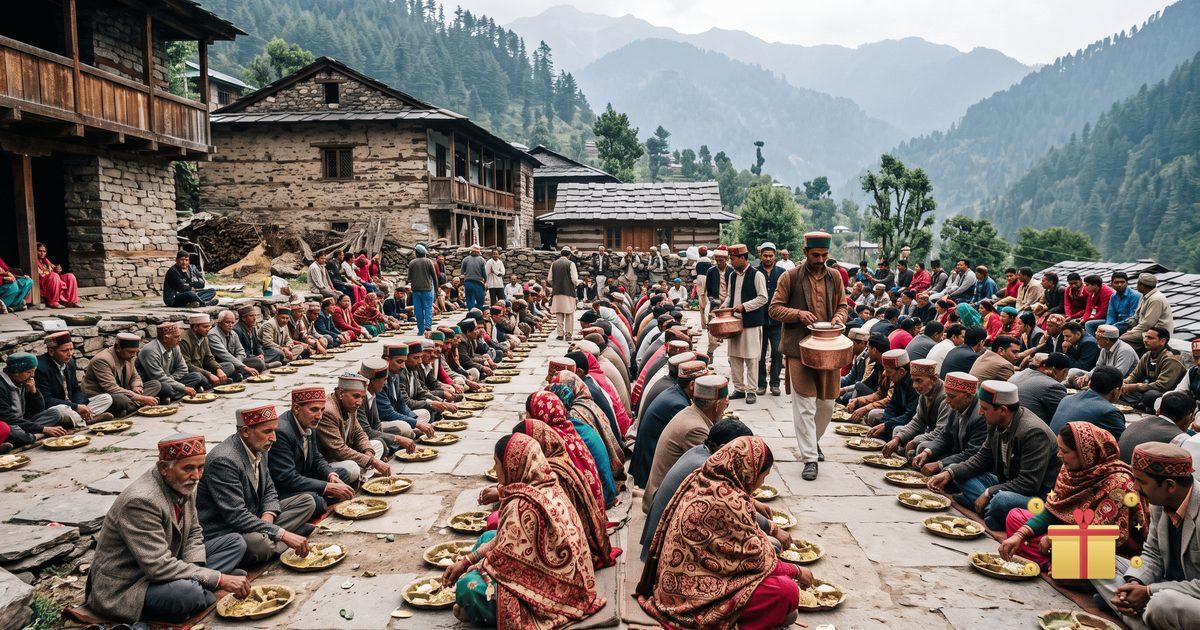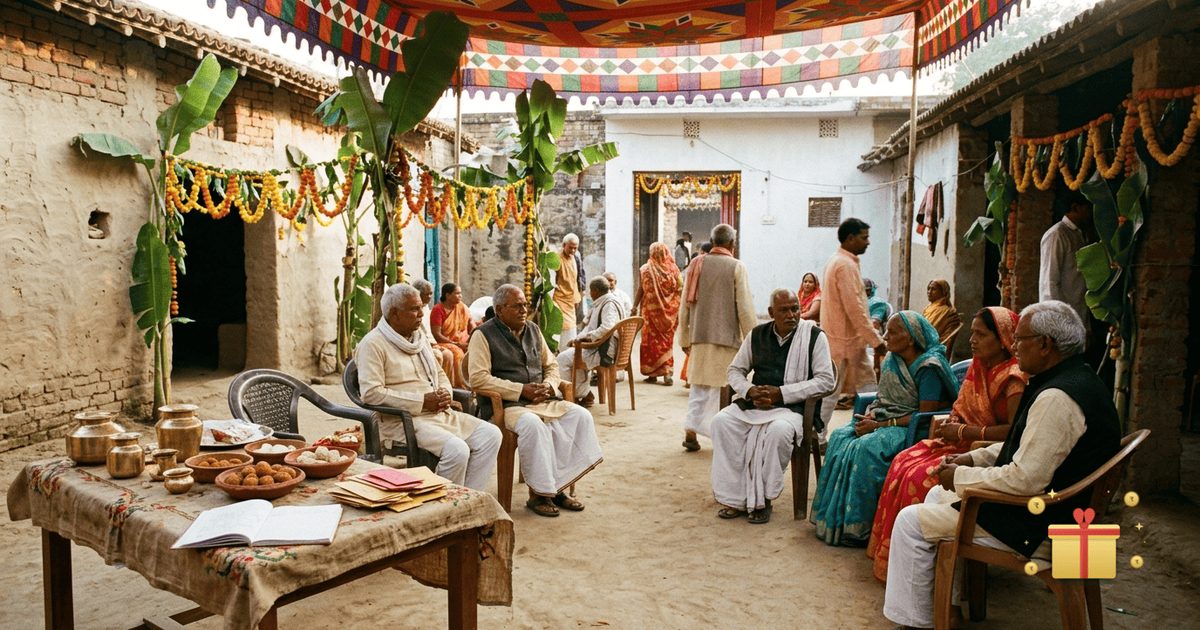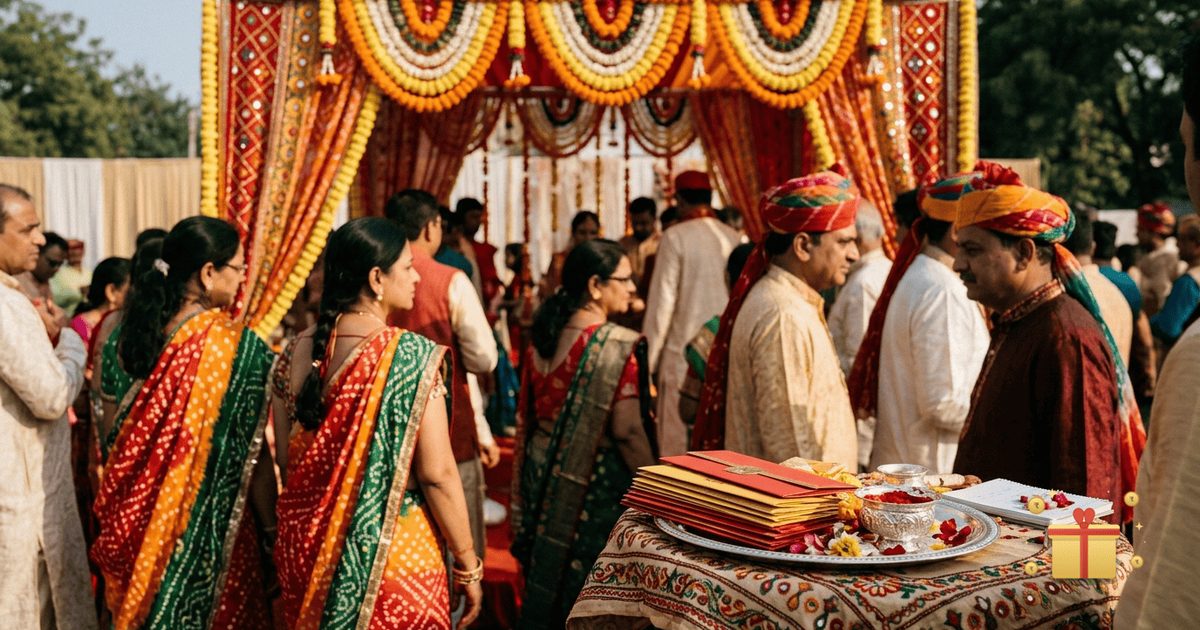
An Uttarakhand wedding gathers a family that is usually scattered, and shagun follows that pattern. Relatives come back from Dehradun, Haldwani, Delhi and further, guests travel from villages a valley away, and the whole thing runs across two or three days rather than one evening. A good share of the giving arrives before the wedding as things rather than money — grain, ghee, milk, firewood, days of somebody's labour — because in the hills a wedding has traditionally been carried by the village as much as by one household. Somebody still has to keep track of all of it, and that job is harder here than it looks.
Garhwal and Kumaon share a great deal and differ in the details, and families within a single village differ too. What follows is how things are generally done, offered as orientation rather than a rulebook.
What shagun means at an Uttarakhand wedding
Shagun is the auspicious gift, and in these families it is rarely only cash: an envelope usually travels with clothes, a shawl or an ornament. The figure ends in one — ₹101 or ₹501 for a token, ₹1,100, ₹2,100 or ₹5,100 at a wedding — so that it reads as an opening rather than a settled sum. Pahari weddings tend to be more restrained than city ones, and a smaller figure is never a smaller sentiment.
What sets Garhwal and Kumaon apart is how much of the giving is not cash at all, and how much of it is time. A neighbouring household sending milk for three days, an uncle who brings a sack of rice, the women of the village who come to draw aipan and cook — in a place where a wedding party could not simply be ordered in, this was the whole economy of the occasion, and in many villages it still is. It is also the part a notebook is worst at holding, which is precisely why it should.
A hill family rarely asked how much someone gave. It asked who came down from which village, who stayed to help clear up, and whose house sent food without being asked.
Where gifts change hands
Fixing the match and the tilak
When a match is settled, the two families visit each other with sweets, dry fruit, clothes and shagun, and in many families a tilak marks the engagement formally. The gifting at this stage is between households rather than from individual guests, and it usually produces the largest single entries of the entire wedding.
The preparations at home
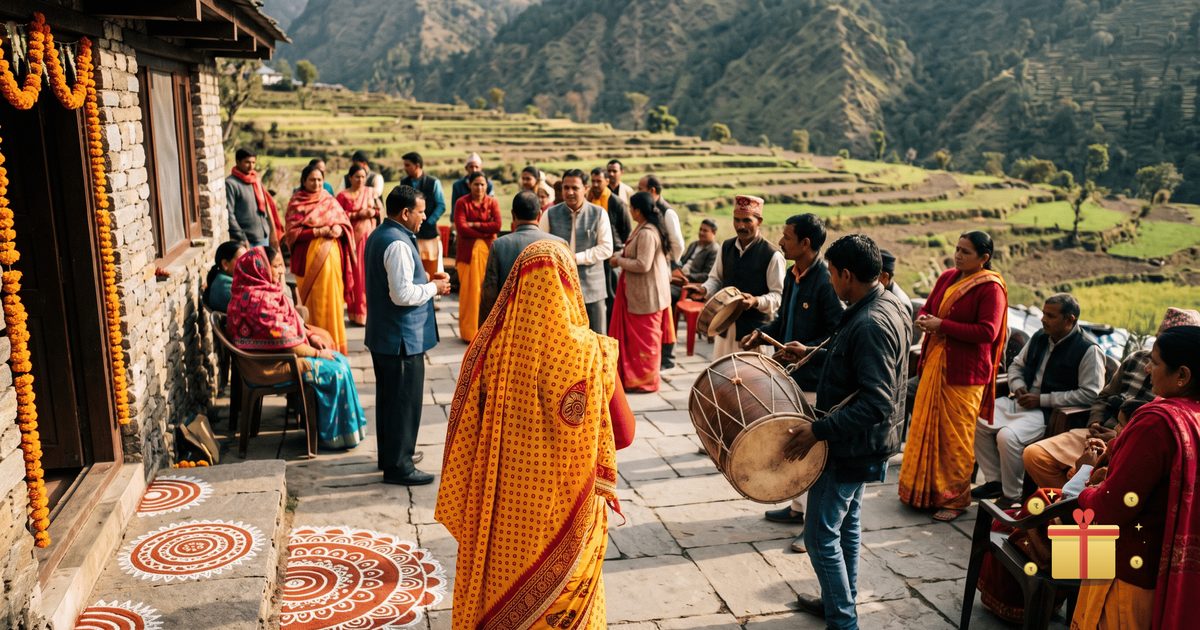
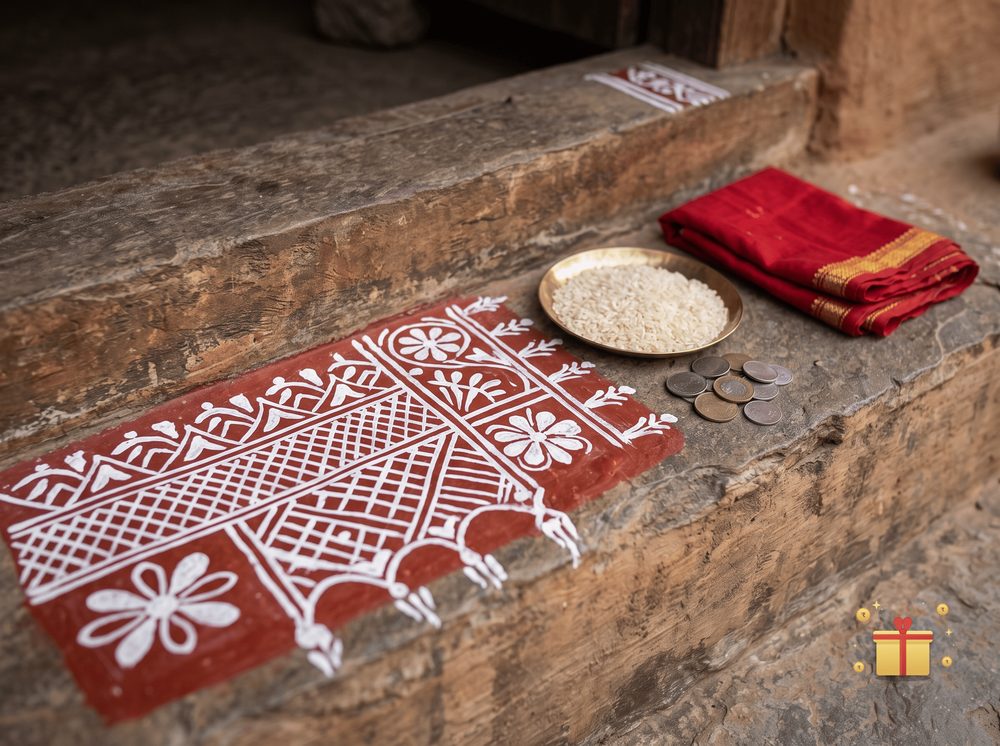
Before the wedding, both houses fill with work that is itself a form of giving. In Kumaon, aipan — the white rice-paste patterns drawn on a red ground at doorways and ritual spaces — is made by the women of the family and the neighbourhood. Many families also hold suwal pathai a few days before the wedding, when rice-flour papads and sesame sweets are prepared together for the occasion. Neither is a register entry, but in many households the people who came to help are remembered as clearly as the people who sent an envelope.
The baraat and the courtyard welcome
The groom's party arrives with dhol-damau in Garhwal and its own music in Kumaon, and is received at the bride's home in a ceremony in the courtyard. In many Garhwali and Kumaoni families the groom is welcomed there by the bride's father, honoured with a tilak and given gifts, before the wedding rituals begin. It is public, crowded and quick, and whatever passes at this moment is easy to lose track of, because everyone involved is busy being welcomed.
Cloth, ornament and the things that are given
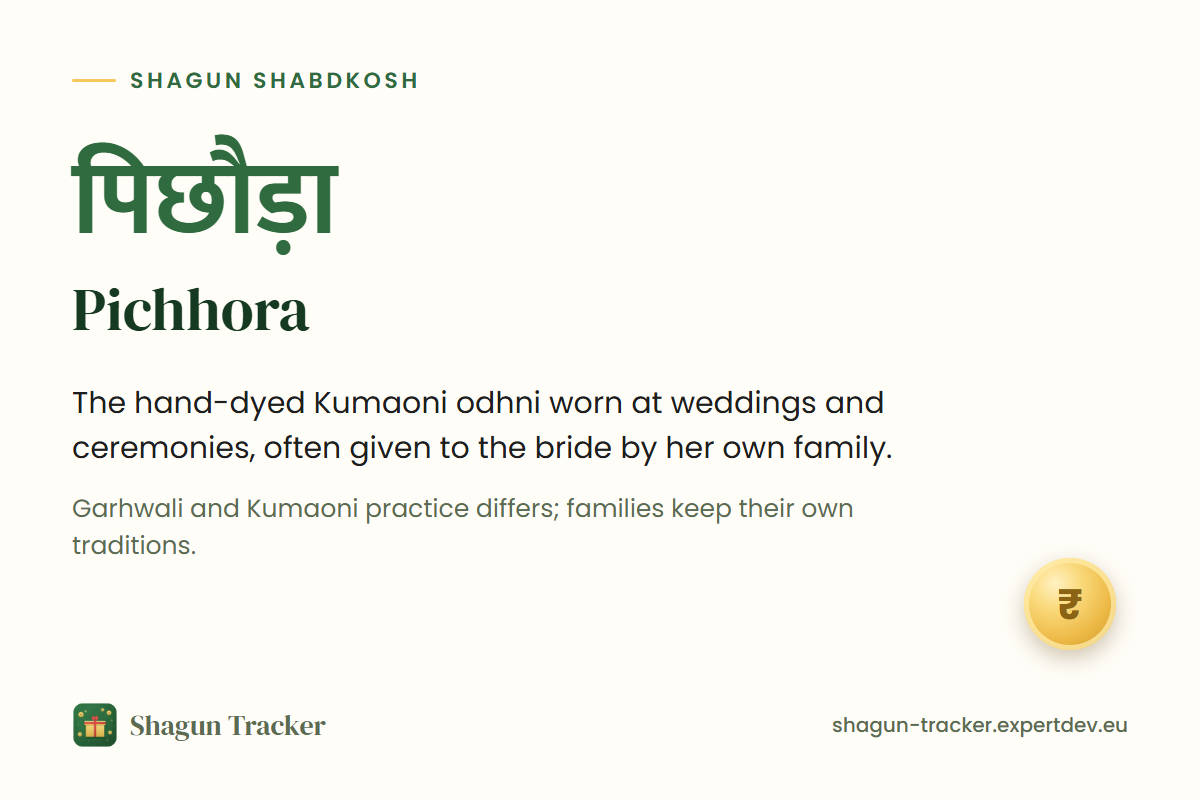
A good deal of Pahari gifting is in cloth and ornament rather than cash. In Kumaon the rangwali pichhora — the bright dyed ceremonial dupatta associated with married women — is closely tied to weddings, and shawls, woollens and jewellery passed between the two families carry real weight. These rarely appear in the register as written entries, though they are often the gifts people actually remember twenty years later.
Small customary gifts
Certain moments carry their own tokens, as they do on the plains: the singing at the door, the bride's sisters and cousins who take the groom's shoes and bargain over their return, the relatives who lead a particular step. The sums are small and the point is the exchange rather than the money. If you are travelling with the baraat, keep a few ₹101 and ₹501 notes somewhere you can reach them quickly.
Bidaai and after
The giving does not stop at the wedding. It continues through the visits between the two households afterwards, and through relatives who come to see the couple once they are back in the city. These later gifts are significant and almost never recorded, because by then the notebook is in a cupboard.
What guests usually give
- Neighbours and people from the village give partly in cash and partly in supplies and work, and the second half counts every bit as much as the first.
- Relatives give by closeness, and usually look first at what that household gave them when the last function was theirs.
- The maternal side gives generously by long custom, as it does throughout north India.
- Family who have moved to the plains — Dehradun, Haldwani, Delhi, further afield — generally give what is normal where they now live, which can be noticeably more than the village figure. Nobody should feel measured against it.
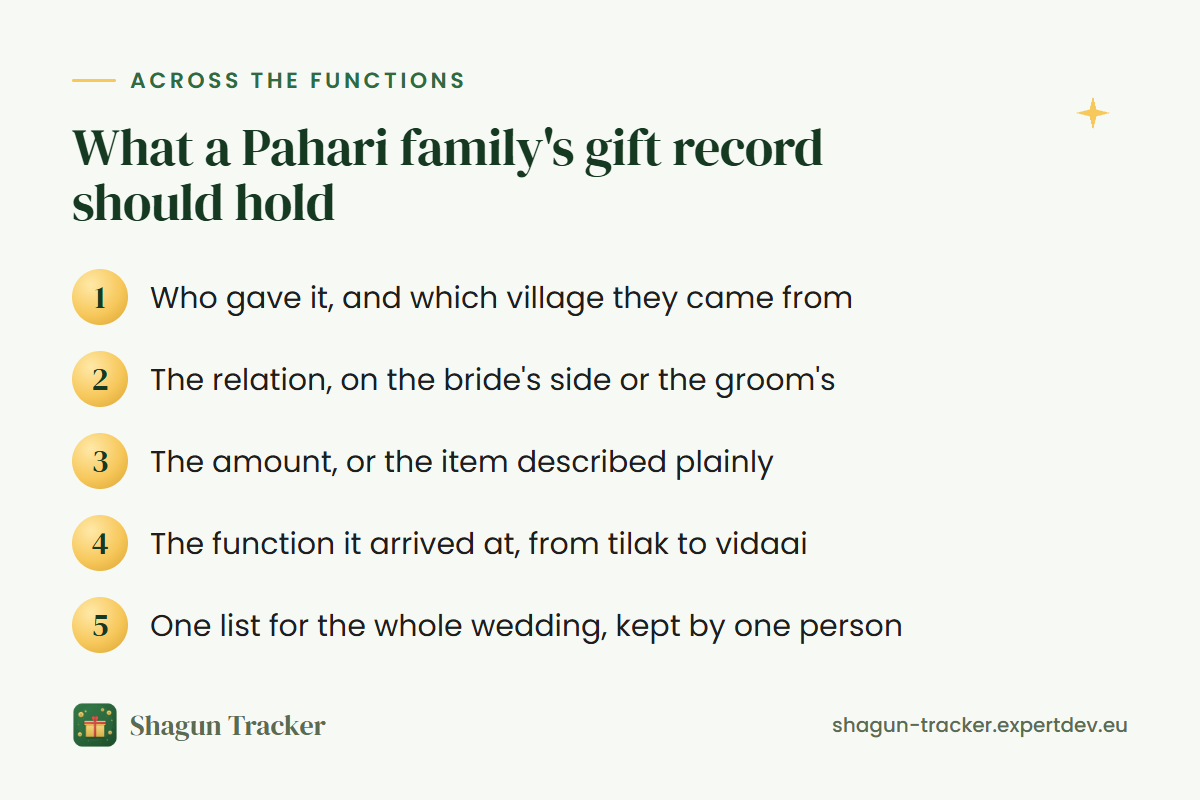
Put your name and your village on the envelope. It matters more here than in a city, because guests arrive from a dozen different villages and a surname on its own identifies nobody. If you want to work the amount out properly, see how much shagun to give at an Indian wedding.
How families keep the record
The usual method is a notebook at the wedding house, kept by one relative who is trusted with it, listing the name, the village and the amount. It is a sound system. Where it comes apart in Garhwal and Kumaon is fairly specific:
- Surnames that repeat down the whole valley. Without the village written beside it, a name in the book identifies nobody, and the village is the first thing that gets dropped when a queue forms.
- A wedding spread over three days, so entries end up in a notebook, a phone and somebody's diary, and the three are never reconciled afterwards.
- Relatives who could not make the journey and send something a week later, by which point nobody is writing anything down.
- Everything given as help rather than cash — the milk, the grain, the two days of cooking — which is usually the most meaningful part of what was given and almost never appears on a page.
- Unnamed envelopes, unidentifiable by the end of the night.
- The notebook itself, damp from a monsoon wedding or left behind in a village house nobody lives in year-round.
Habits that hold up
- Appoint one recorder for all three days, not one per function, and keep everything in a single list.
- Write it down as it is handed over, never afterwards from memory.
- Village beside every name, always. If you take one thing from this article, take that.
- Mark the relation — maternal side, paternal side, neighbour, friend, colleague.
- Record help and supplies in plain words: "sent milk for three days", "brought rice", "came two days early to cook".
- Leave the list open for a fortnight, so late gifts and the visits afterwards get in as well.
- Send a copy to two relatives the same week, ideally ones living in different places.
Keeping the record on a phone
A lot of families now keep the list on a phone, and the reason is the shape of an Uttarakhandi family rather than any love of apps. The people who need to see the record live in three different places. One that can be sent to a brother in Delhi the same night is worth considerably more than one sitting in a cupboard in a village house that is locked for eight months of the year.
Shagun Tracker handles this well. You make an event for the wedding, add each guest with a name, a village address and a relation, and record what came in — cash, clothes, gold or something else — using the notes line for whatever does not fit a number, such as supplies sent or days of help given. The totals build as you type, a name can be searched later in Hindi or English, and the list exports as a PDF, CSV or backup file to send to relatives wherever they are. It works offline, which is the part that counts when the village has no network for two days and the wedding does not stop for it.
If an older cousin already keeps the family's list in an Excel sheet, that can be brought in as a CSV so the old and the new sit together. Hosts organising the table itself should read the shagun counter checklist for hosts beforehand.
Why it is worth writing down
A record does not turn a wedding into an account. In Garhwal and Kumaon it does closer to the opposite: it keeps hold of the fact that people came down from villages that take half a day to reach, and did not arrive empty-handed. When their function comes, the family will want to give back properly rather than guess, and memory is not up to the job after fifteen years. The same instinct appears in Himachali wedding gifting and the dham, in the neota register custom of Haryana and in Punjabi shagun and milni traditions — the same idea in different clothes, and every version of it depends on somebody having written it down.