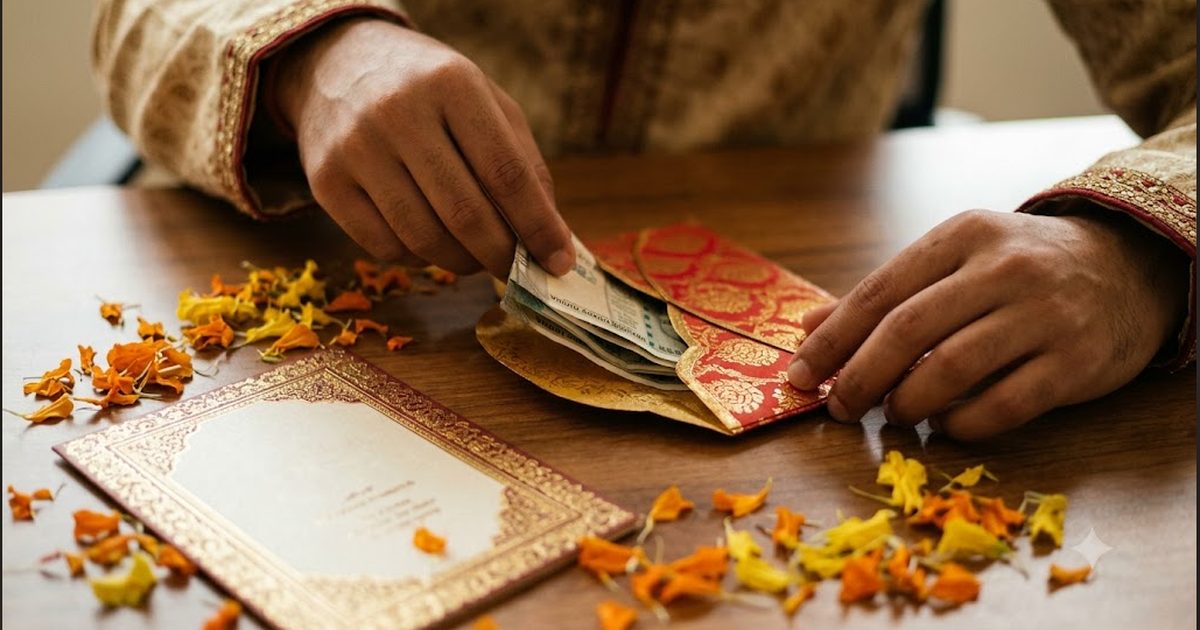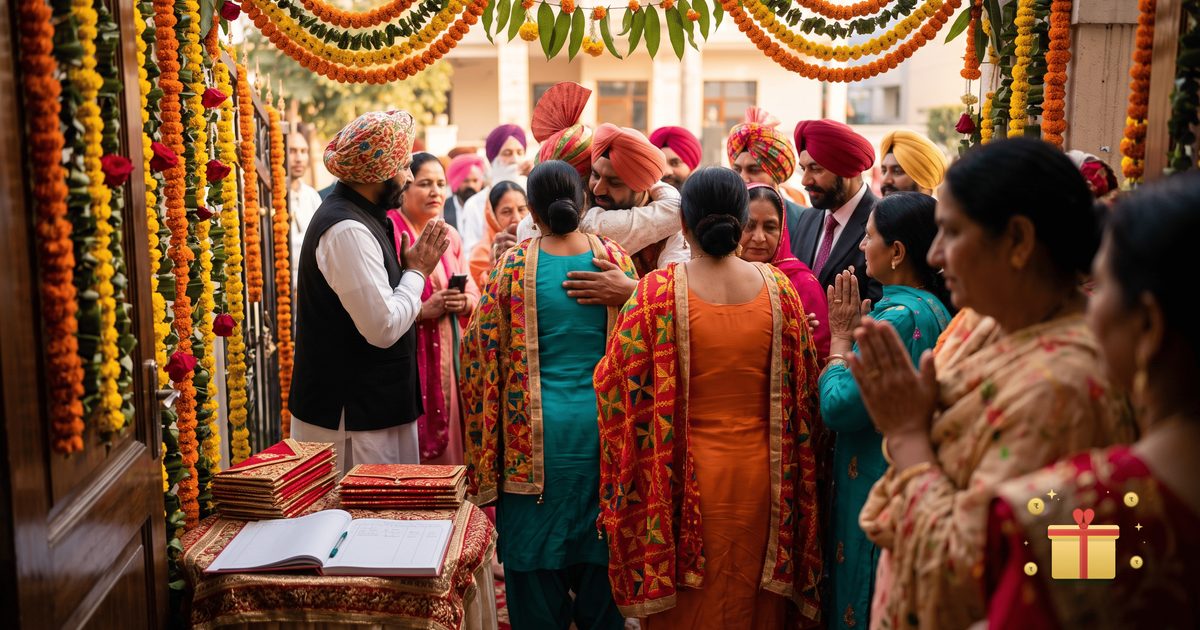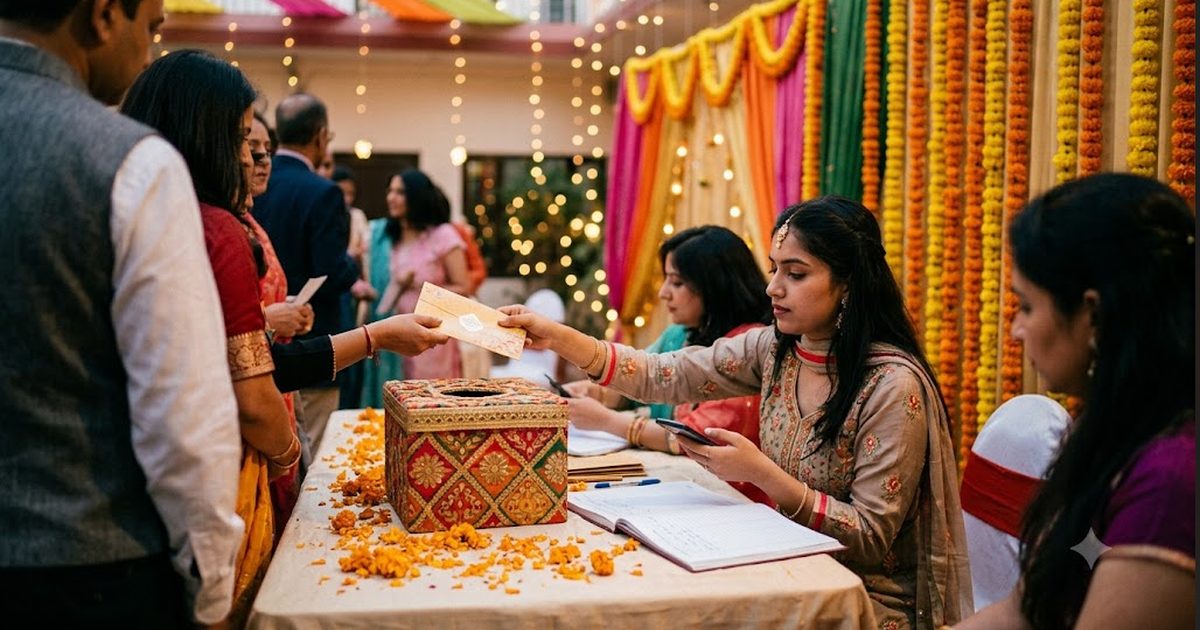
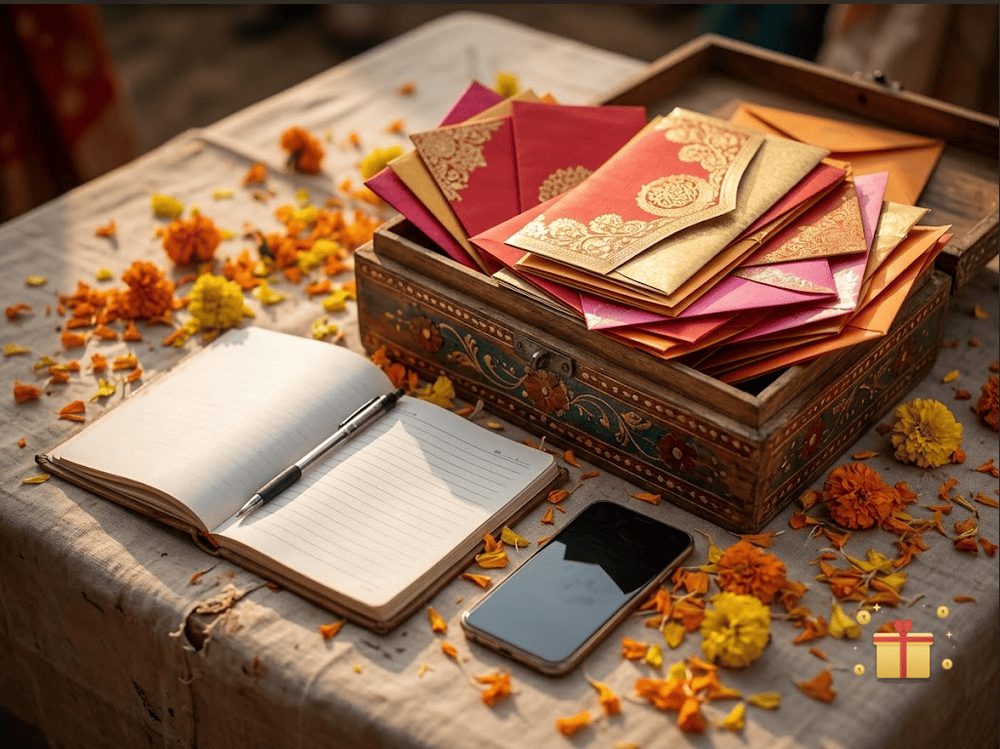
Every family function produces one person holding a register, a pen and a box of envelopes, usually without much warning. The shagun counter is where a few hundred relationships get converted into a list, and if that list is wrong, the family finds out years later at the next wedding, when nobody can remember what the Sharmas gave.
This is a working checklist for the person running that table. It covers what to set up beforehand, what to write for each guest, how to handle the awkward cases, what to do at the end of the night, and how to close the loop with thank-yous. None of it is complicated. All of it gets skipped under pressure.
A week before: decide, don't improvise
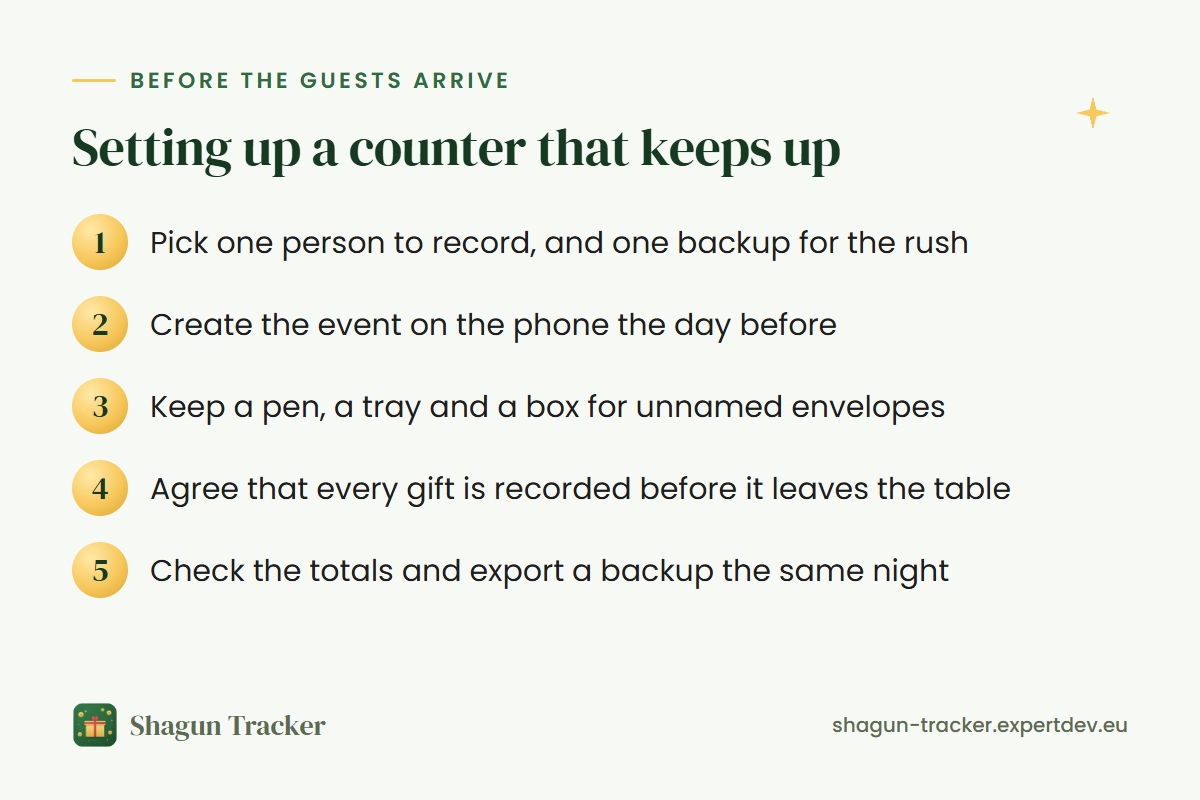
- Name the recorder and a backup. One person owns the list. The backup takes over during the meal and when the first person needs a break. Both should know the plan before the day.
- Pick one method and stick to it. A register or a phone, not both, and not a register plus three people's WhatsApp notes.
- Agree a table location. Near the entrance, visible, with a chair and somewhere to put the box. Guests should not have to hunt for it.
- Brief the greeters. The relatives welcoming people at the door need to know where to send envelopes, and to stop collecting them in their own pockets.
- Decide about UPI. If money will arrive digitally, decide whose number is being given out and who checks that phone during the evening.
- Plan for more than one function. Engagement, mehndi, wedding and reception each need their own list. Merging them afterwards is far harder than separating them at the time.
On the day: the counter setup
- A register or a charged phone, plus a power bank. The table dies if the phone does.
- Two pens. One always disappears.
- A closed box or bag for envelopes, kept behind the table, not on it.
- A separate envelope or clip for unnamed envelopes, set up before the first guest arrives.
- Loose ₹1 coins, for the family's own giving and for guests who ask.
- A small tray for gifts in kind, so parcels do not end up stacked in a corner unrecorded.
What to write for every guest
One line per guest or family, filled in as the gift is handed over, never from memory later:
- Name in full. "Sharma ji" is not a record.
- Address or town. This is what separates three guests with the same name in five years' time.
- Relation. Paternal side, maternal side, friend, colleague, neighbour. It takes two seconds and it is the first thing you will want later.
- What was given. The amount for cash; a plain description for anything else.
- Contact number if it is easy to get, which makes the thank-you round and the next invitation much simpler.
The test for a good entry is simple. Read it back in ten years with no memory of the day: can you say who this person was, and what they gave? If not, add a word or two now.
The cases that go wrong
Envelopes with no name
They arrive at every function. The fix is to catch them at the table rather than at midnight: if an envelope is blank, ask politely who it is from and write the name on it yourself. For any that slip through, keep them in the separate pile and note the rough time and who handed it over. At the end of the night, go through the pile with two or three relatives while memories are fresh. Whatever cannot be placed goes into the record as unidentified, with the amount. Do not leave it out of the totals.
Several people collecting
The most common failure at any function. An uncle at the door, a cousin near the stage and a friend by the dining hall each build a small pile, and none of them writes anything down. Announce clearly within the family that every envelope goes to the counter, and if someone does collect a handful, they hand it over with names as soon as they reach the table.
Gifts in kind
Clothes, silver, jewellery, a dinner set, a household item. These take longer to record than a number, so they are the first thing to get skipped when a queue builds. Write them in plain words: "Banarasi saree", "gold chain", "silver thali set". If it is a wrapped parcel, write the giver's name on the wrapping straight away and open it later; recording it as "parcel, unopened" is fine as long as the name is attached.
One guest, two gifts
Close relatives often give cash and something in kind together. Record both against the same person rather than making two separate entries, so the picture of what that family gave stays whole.
Digital transfers
Money that lands on a phone while the register sits on a table is the newest way for a gift to vanish. Whoever's number is circulating should check it two or three times during the evening and read the names across to the counter. Reconcile the full transaction history against the list at night.
The guest who cannot attend
Gifts sent through someone else, or before the function, or a week after, belong in the same list. Add them as they come in and note who delivered them.
At the end of the night
- Count with two people present. Never alone, never in a crowd.
- Compare the count against the recorded total. A gap here almost always means a missed entry, not a missing envelope.
- Work the unnamed pile while the evening is still fresh in everyone's mind.
- Add the stragglers: envelopes handed to relatives during the meal, gifts left at the house, transfers that came in late.
- Make a copy immediately. Photograph every page of the register, or export the digital list, and send it to one other family member. One notebook in one house is a single point of failure.
- Put the cash away properly, with one person clearly responsible for it.
How families keep the record afterwards
The list only pays off if it survives. The traditional register works and has worked for generations, as long as somebody copies it before the ink fades or the house is moved. Store it with the wedding album, not in a drawer of miscellaneous papers.
Many families now keep the same list on a phone, for ordinary practical reasons: the phone is already at the table, the totals add themselves, and a name can be searched in seconds instead of read page by page. Shagun Tracker is built for this job. You create an event for each function, add each guest with name, address, relation and contact, and record what they gave, whether cash, clothes, gold or something else, including more than one kind of gift for the same guest. Search works across Hindi and English, so typing "शर्मा" finds "Sharma". The list exports as a PDF, a spreadsheet or a backup file to share with relatives, and you can lock an event so nobody can change or delete its records afterwards. It works offline, which is exactly what you need in a hall with no signal. If you already keep an Excel sheet, it can be imported into the event; and if you have an old paper register, the Scan Register feature can read a photographed page and let you check each line before saving, which needs internet and your own free Google Gemini API key added in settings.
Closing the loop: thanking guests
Within a week, while the list is still in front of you, go through it and thank people. A call to the elders, a message to everyone else, and a specific mention of what they gave where it was a gift in kind. This is the part that turns a ledger back into a relationship, and it is far easier when the record has names, relations and numbers in it.
Then put the list somewhere the family can find it. The next time someone in your circle has a wedding, this is the document that tells you what to give, which is precisely how deciding a shagun amount actually works in practice. It is the same reason a Tamil family keeps its moi notebook for decades and a Haryanvi family keeps its neota record. You are not keeping accounts. You are keeping track of who stood with you.