In a Punjabi wedding, shagun is not a gift in the ordinary sense. It is a blessing that happens to take the form of money, clothes or jewellery. The word turns up at every stage of the wedding, from the first small ceremony that fixes the match to the envelope quietly handed over at the reception, and each time it carries the same idea: this family wishes you well, and here is something to mark it.
Anyone who has helped host a Punjabi wedding also knows the other side of it. Several hundred guests arrive over a few hours, each with a lifafa, and someone in the family is responsible for making sure every single one is written down correctly. This guide covers both sides: what the customs mean, and how to keep the record straight.
What shagun means in Punjabi families
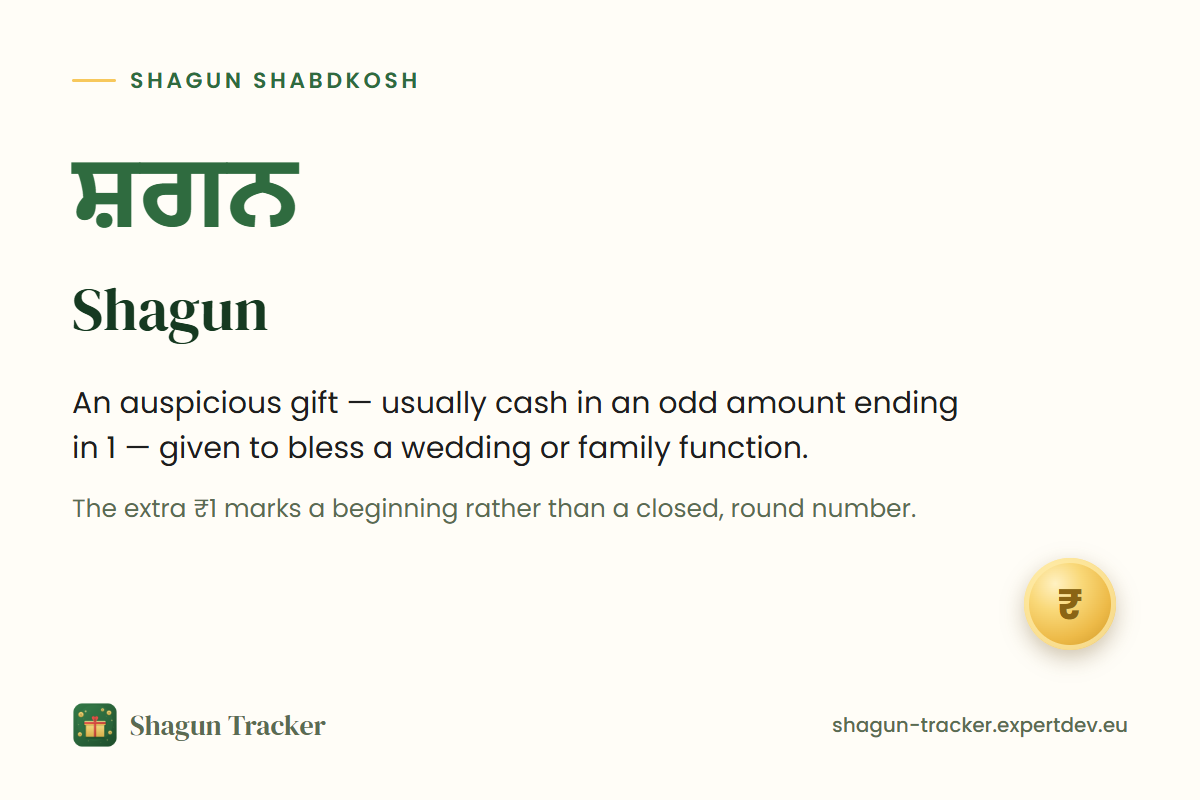
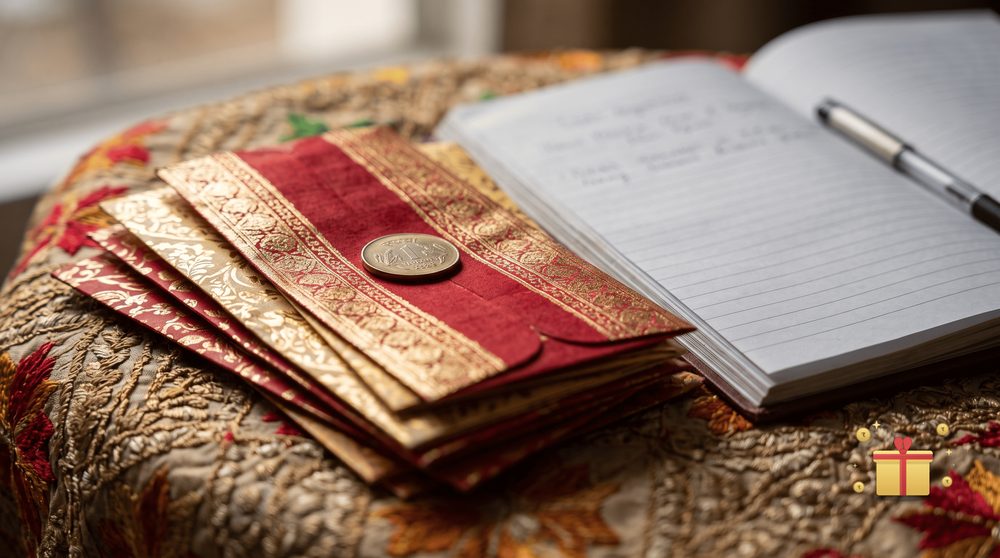
Shagun is closely tied to the idea of an auspicious beginning. The amount given is meant to be a starting point rather than a settled sum, which is why almost every envelope contains an odd figure that ends in one: ₹101, ₹501, ₹1,100, ₹2,100, ₹5,100, ₹11,000. Families often keep a supply of ₹1 coins for exactly this purpose.
The gift is also a statement about the relationship between two families rather than two individuals. This is why the record matters so much. When the giver's own family has a function, what they gave is very likely to shape what they receive in return. Older relatives frequently remember these amounts for decades.
A Punjabi family's shagun register is really a relationship ledger. It says who stood with you, and roughly how much. That is why it gets kept for years, and why losing it feels like losing something more than paper.
The moments where shagun changes hands
Roka and shagun ceremony
The first formal gifting usually happens when the match is settled. The girl's family visits the boy's family or the other way round, and shagun is given along with sweets, dry fruit and clothes. The amounts here are usually larger than at the wedding itself, and are given between families rather than by individual guests.
Sagai
At the engagement, rings are exchanged and relatives on both sides hand over envelopes and gifts. This is often the first function where a large guest list is involved, which makes it the first real test of whoever is keeping the register.
Milni
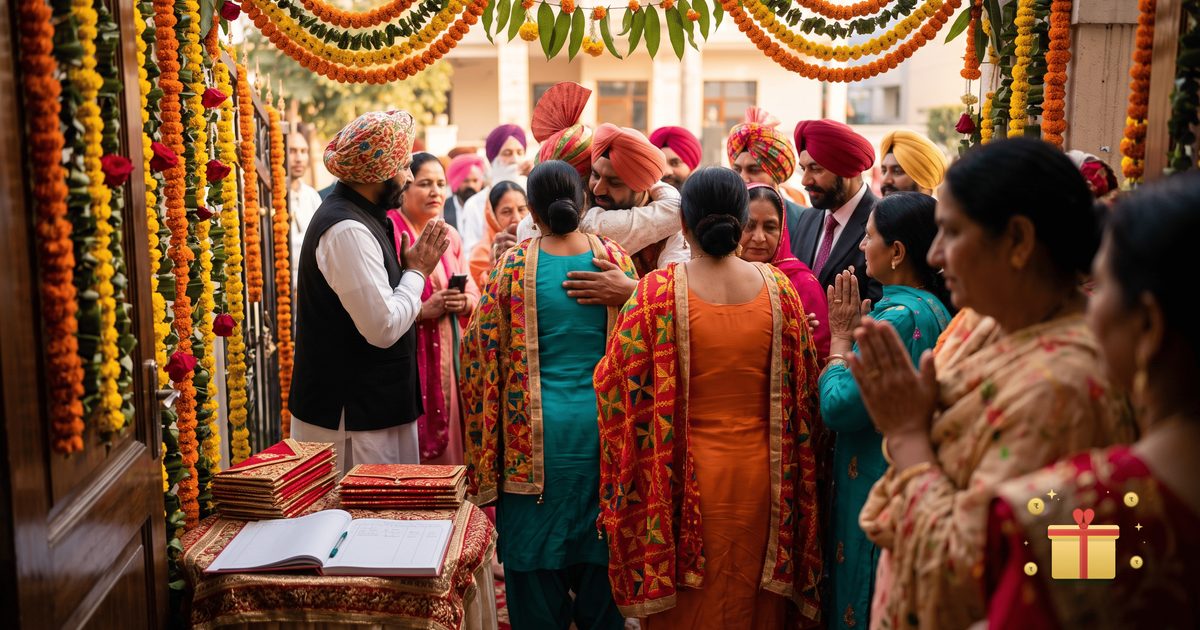
On the wedding morning, the two families meet formally. Matching relatives are paired up, the chacha of one side with the chacha of the other, the mama with the mama, and each pair is introduced, garlanded and often given an envelope. Milni happens in the middle of a noisy, busy welcome, and it is where records most often slip.
The wedding and reception
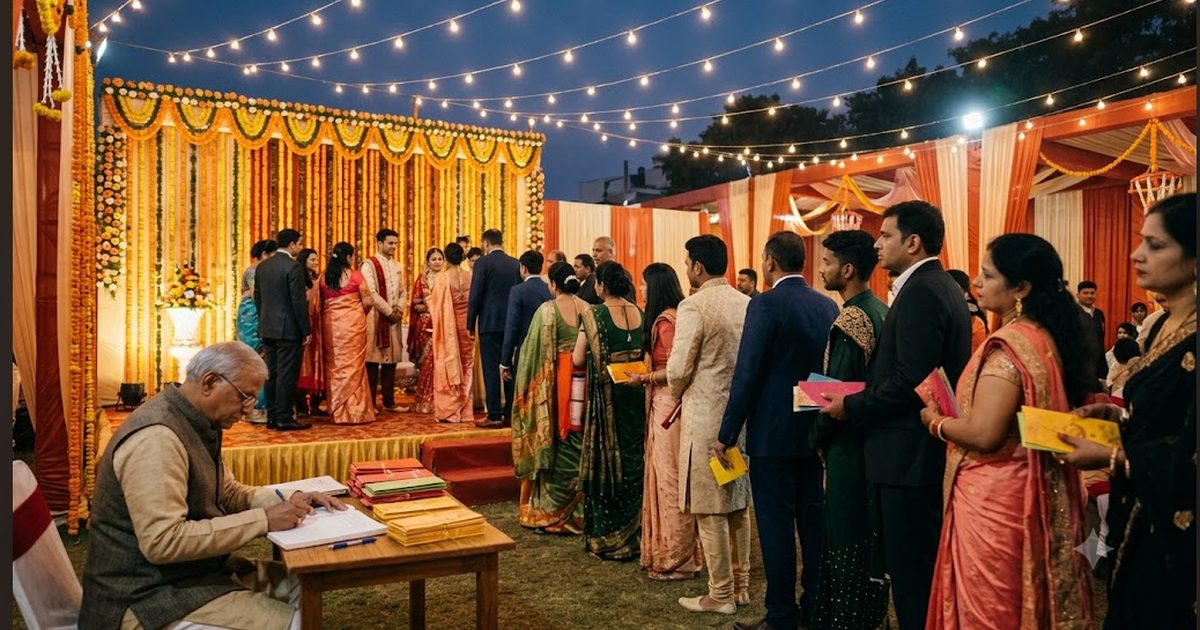
This is the big one. Guests hand envelopes to whoever is at the gift table, sometimes to a family member on the way to their seat, sometimes to the couple on stage. Cash, clothes and jewellery all arrive together, and the same guest may give more than one kind of gift.
Vidaai and after
Gifting does not end with the wedding. Shagun continues through the visits that follow, and the record of who gave what quietly becomes the family's reference for the next function in either household.
How much do people usually give?
There is no fixed rule, and anyone who tells you there is has only seen one corner of Punjab. What holds generally:
- Colleagues and acquaintances tend to give a modest amount that acknowledges the invitation.
- Friends usually give more, often agreeing an amount among themselves so nobody is out of step.
- Relatives give according to how close the relationship is, and frequently in line with what that family gave them earlier.
- Mama ji and the maternal side are traditionally expected to give generously, and in many families this is a matter of some pride.
Two things matter more than the figure. First, the amount should end in one. Second, the envelope should have the giver's name on it. An unnamed envelope creates a real problem later, because the family cannot thank the giver properly or reciprocate at their function.
Keeping the record: what actually goes wrong
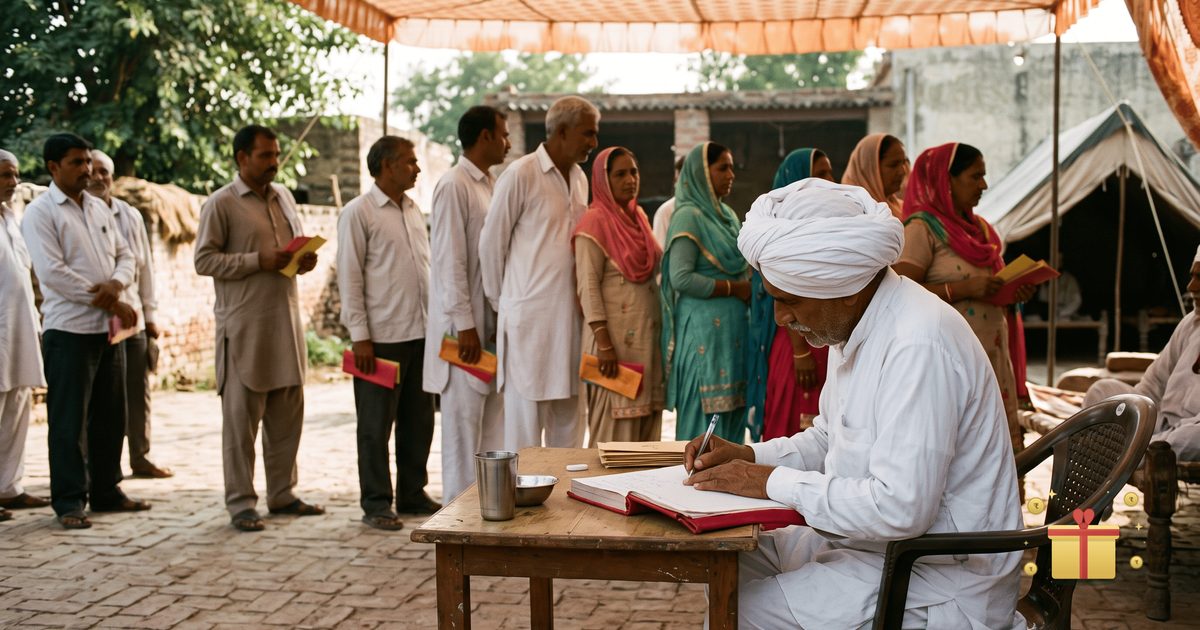
The traditional method is a register at the gift table, with a column for the name, the address and the amount. It works, until it doesn't:
- Envelopes with no name. They arrive in every wedding, and by the end of the night nobody can identify them.
- Two people writing in the same register. Entries get duplicated or skipped when the queue builds up.
- Non-cash gifts. A suit length or a gold chain is harder to note down quickly, so it often gets left out entirely.
- The register itself. Ten years later the ink has faded, or the notebook was lost in a house move, right when the next function makes it relevant.
A few habits that help
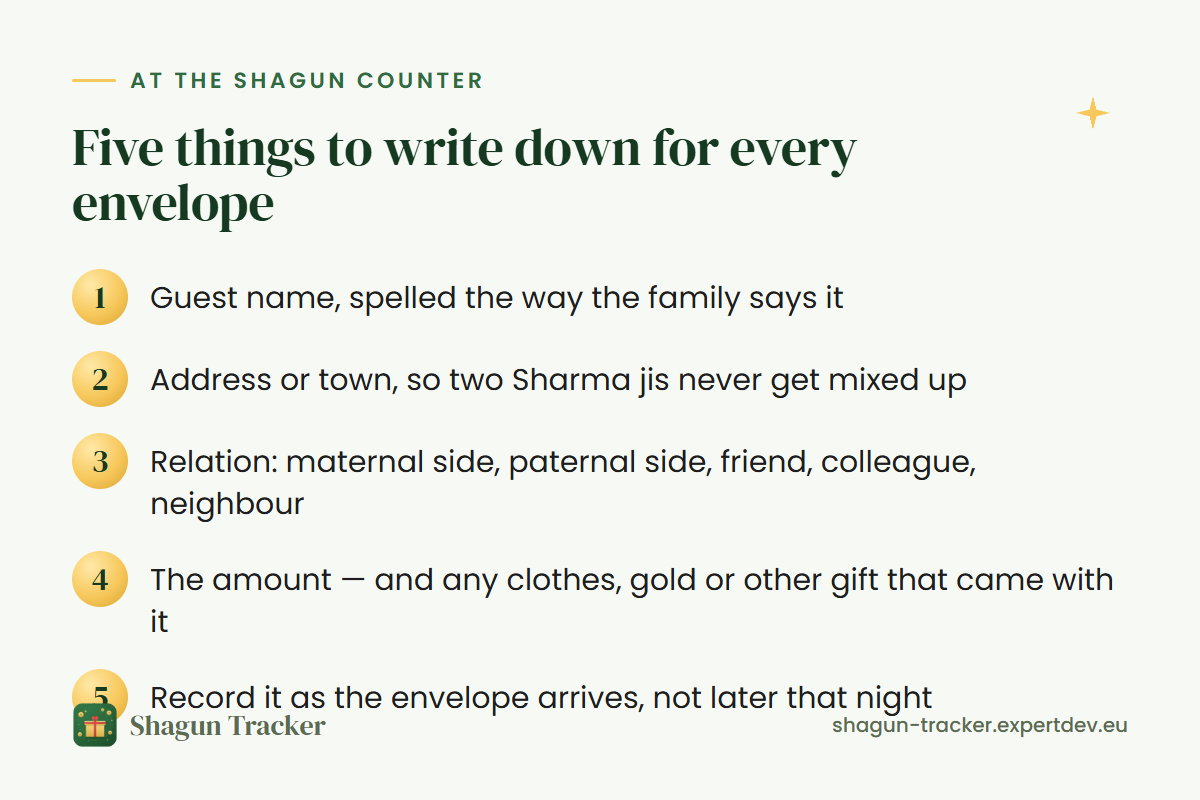
- One person, one device, one list. Decide in advance who is recording, and let everyone else hand envelopes to that person.
- Record at the moment of receiving. Not later that night, when nobody remembers whether the ₹2,100 was from the neighbours or the office.
- Note the relation, not just the name. "Sharma ji" means nothing in five years. "Sharma ji, colleague, Sector 21" does.
- Write down non-cash gifts too, in plain words: a Banarasi saree, a gold chain, a dinner set.
- Make a copy the same week. Photograph the register pages or export a digital file and send it to two family members.
Doing it on a phone instead
The reason many families have moved the shagun register to a phone is not novelty. It is that the phone is already in your hand at the gift table, it does the arithmetic for you, and the list can be searched afterwards in seconds instead of being read page by page.
Shagun Tracker was built for exactly this. You create an event for the function, add each guest with their name, address and relation, and record whatever they gave, whether that is cash, clothes, gold or something else. Totals update as you go, you can search any name in Hindi or English afterwards, and the whole list exports as a PDF to share with the family. It works offline, which matters in a banquet hall basement with no signal.
The point of keeping the record
None of this is about treating a wedding as a balance sheet. It is the opposite. The record exists so that when their daughter marries, or their grandson has a mundan, you remember exactly who stood with your family and what they gave, and you can return it properly. That is what vyavhar means in practice, and it only works if somebody wrote it down.