Bihar wedding shagun customs are built on one simple idea repeated in a dozen forms: when something good happens in a family, the people around them mark it with a gift, and the family remembers. That gift might be an envelope at the reception, a set of clothes carried to the tilak, a few notes pressed into a cousin's hand at vidaai. The scale changes; the intention behind it does not.
If you are attending a wedding in Bihar, you mostly want to know what is expected of you and when to hand it over. If you are hosting one, the problem is different and larger, because several hundred envelopes will reach you over a few hours and someone has to write down every one of them correctly. This guide covers both.
What shagun means here
Shagun is a blessing given in a form you can hold. The amount inside is meant to read as a beginning rather than a settled figure, which is why it nearly always ends in one: ₹101, ₹501, ₹1,100, ₹2,100, ₹5,100, ₹11,000. Families keep ₹1 coins for the purpose, and an envelope that arrives with a round figure is quietly noticed.
Behind that is vyavhar — the long reciprocity between two households. What you give at someone's wedding tends to shape what comes to you when your own family has a function, and a great many elders carry these details in their heads for thirty years without writing anything down.
Practice varies a great deal across the state. Mithila, Magadh, Bhojpur, Anga and Seemanchal families all do this differently, and so do two neighbours in the same lane. Nothing here is universal; it is the general shape of the thing.
Where gifting happens across the functions
Cheka
In many families the alliance is first marked at a small function, often called cheka, where the two sides meet and the match is acknowledged with sweets, clothes and a modest exchange of gifts. It is usually a close-family affair, which is why it is often the last function anyone thinks to record — and later, the one people wish they had.
Tilak
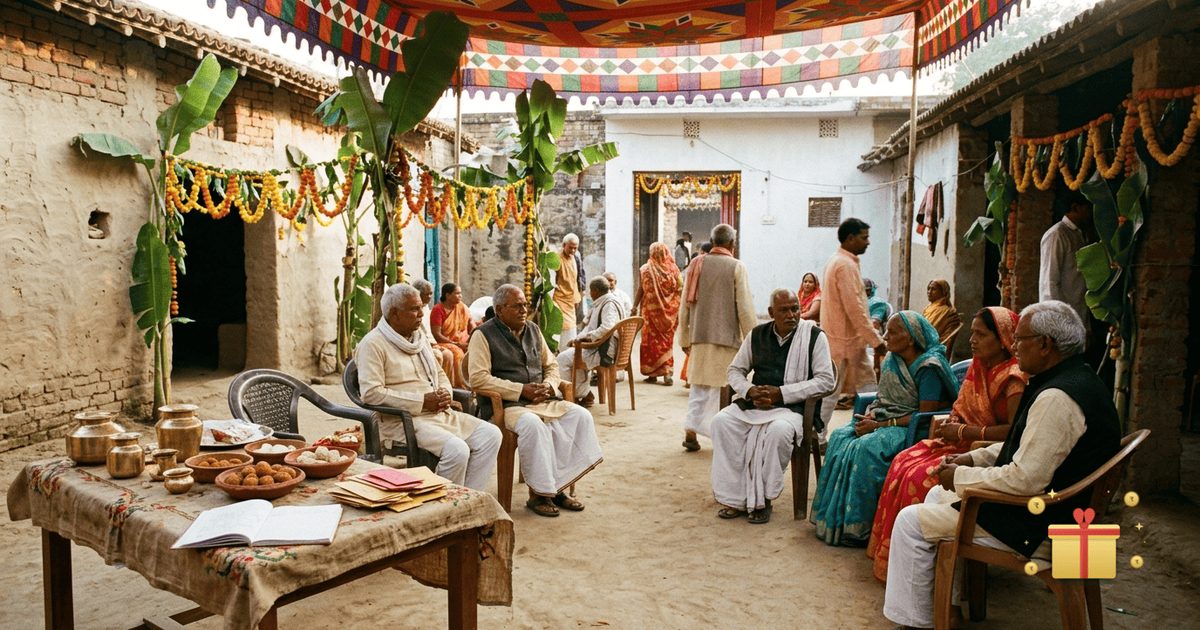
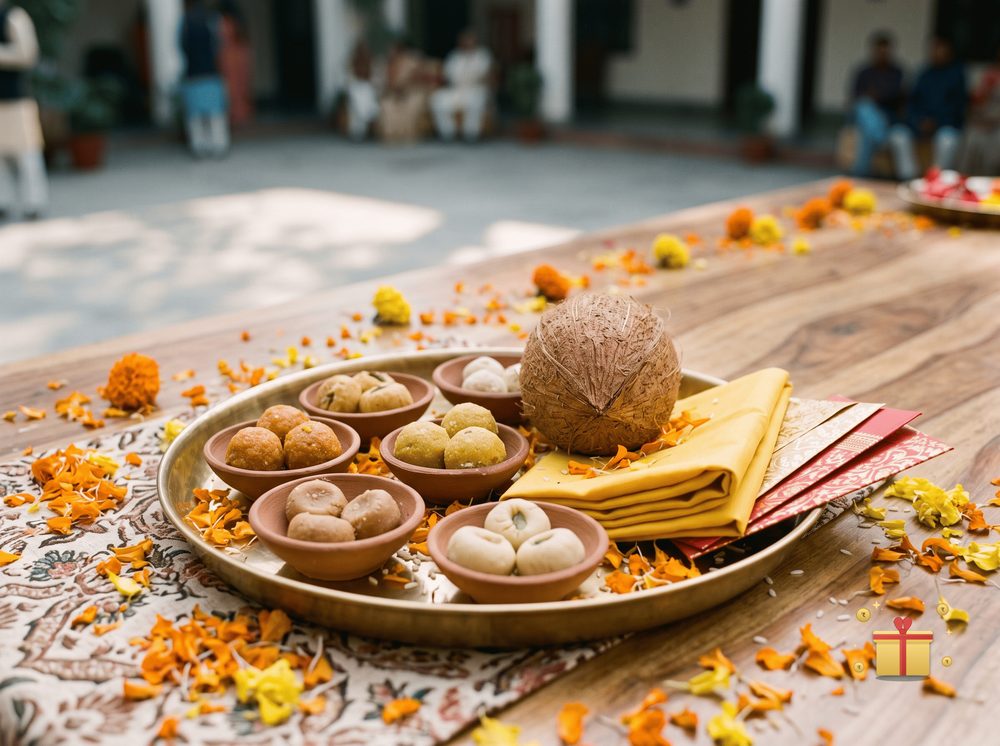
Tilak is the formal sealing of the alliance. Men from the bride's family go to the groom's home, a mark of kumkum or sandalwood is applied to the groom's forehead, and blessings and gifts pass between the two households. In parts of Bihar this is celebrated nearly as elaborately as the wedding day, with a full guest list and a feast. Many families today deliberately keep it small and symbolic, treating it as a blessing rather than an occasion for display, and there is nothing lacking in doing so.
What is worth saying plainly: gifting between two families should be voluntary, mutual and within what each household is comfortable with. A wedding is not a negotiation, and nothing in these customs requires one family to meet a figure set by another.
Matkor and haldi
The home functions in the days before the wedding — the matkor, the haldi, the evenings of singing — bring a steady flow of small gifting. Clothes, bangles and envelopes move informally, handed to whoever is standing nearest. This is where records vanish.
The wedding day
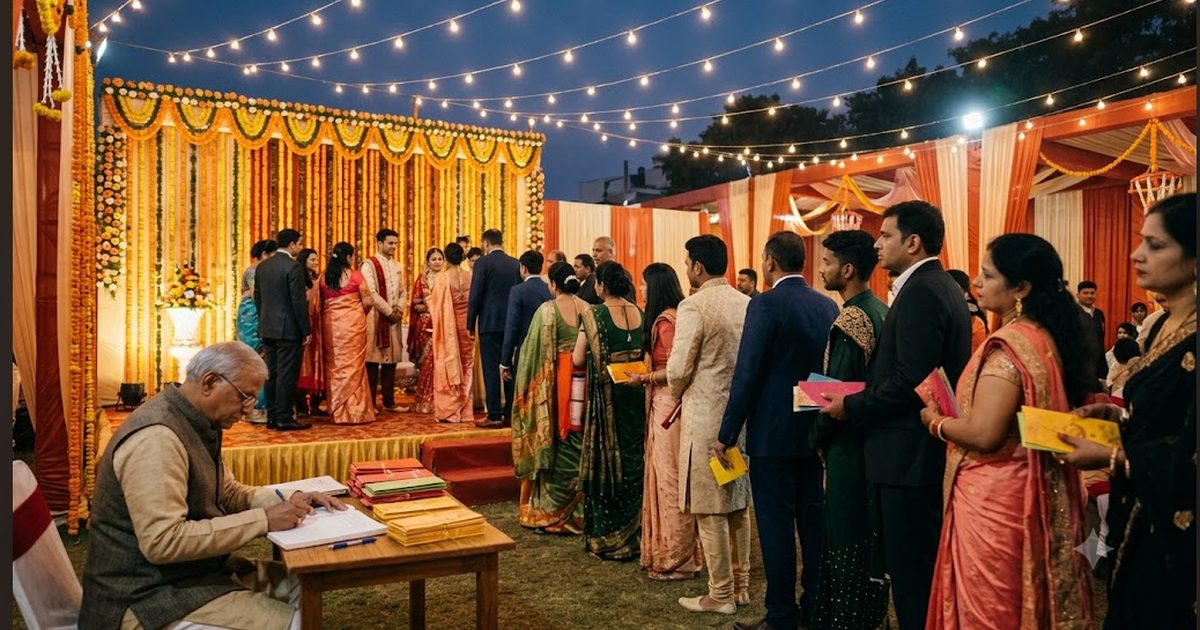
The baraat arrives, the groom is welcomed, and the guest gifting begins in earnest. Envelopes reach the gift table, a cousin at the gate, or the couple on the stage. Cash, clothes and jewellery all arrive in the same hour, and one guest often gives more than one kind of gift.
Neg and vidaai
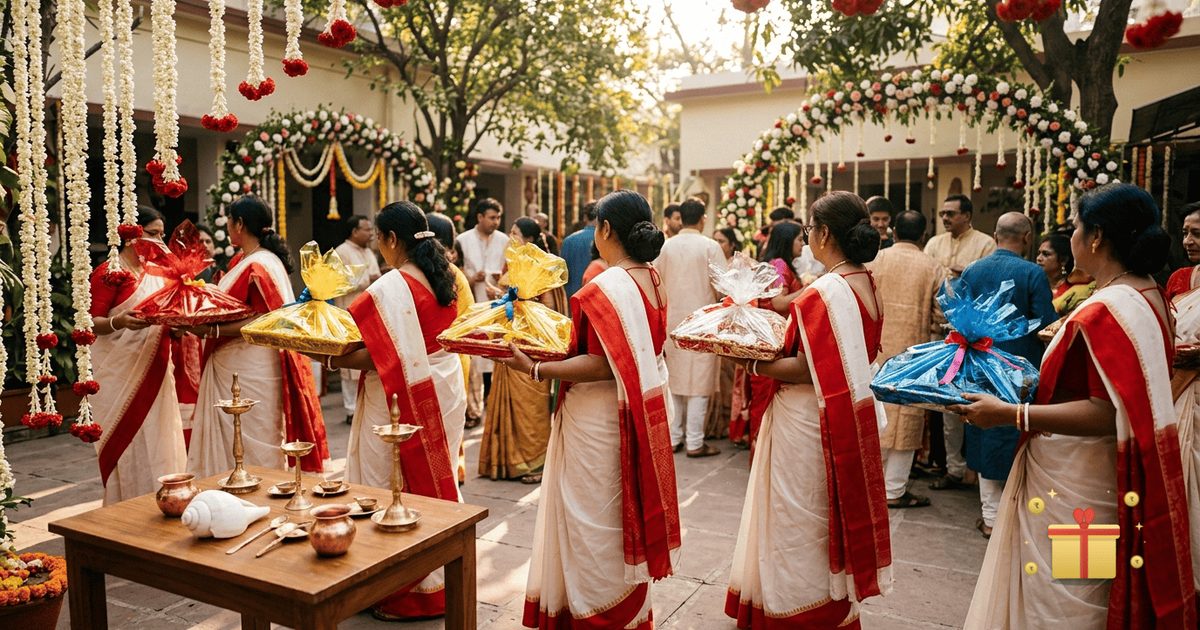
Neg is the customary gifting to the people with a particular role in the wedding — the bride's or groom's sisters, the young cousins, the barber, the singers. The amounts are usually small, given with good humour and a certain amount of theatrical bargaining. Who gets neg, and for what, differs from district to district. Gifting continues through the vidaai and the visits that follow it.
How much do people give?
There is no correct number, only a sense of proportion. Broadly:
- Colleagues and acquaintances give a modest odd amount that acknowledges the invitation.
- Friends give more, and often agree a common figure among themselves so nobody is out of step.
- Relatives give according to closeness, and frequently in line with what that family gave at their own function.
- The mama and the maternal side traditionally give generously, and in most families this is a point of pride rather than obligation.
Two habits matter more than the figure. Keep the amount odd, and write your name and your village or locality on the envelope. "Singh ji" is not a name the hosts can act on a year later; "Singh ji, Baba's colleague, Danapur" is. If you would like the reasoning set out at length, see how much shagun to give at an Indian wedding.
How families keep the record
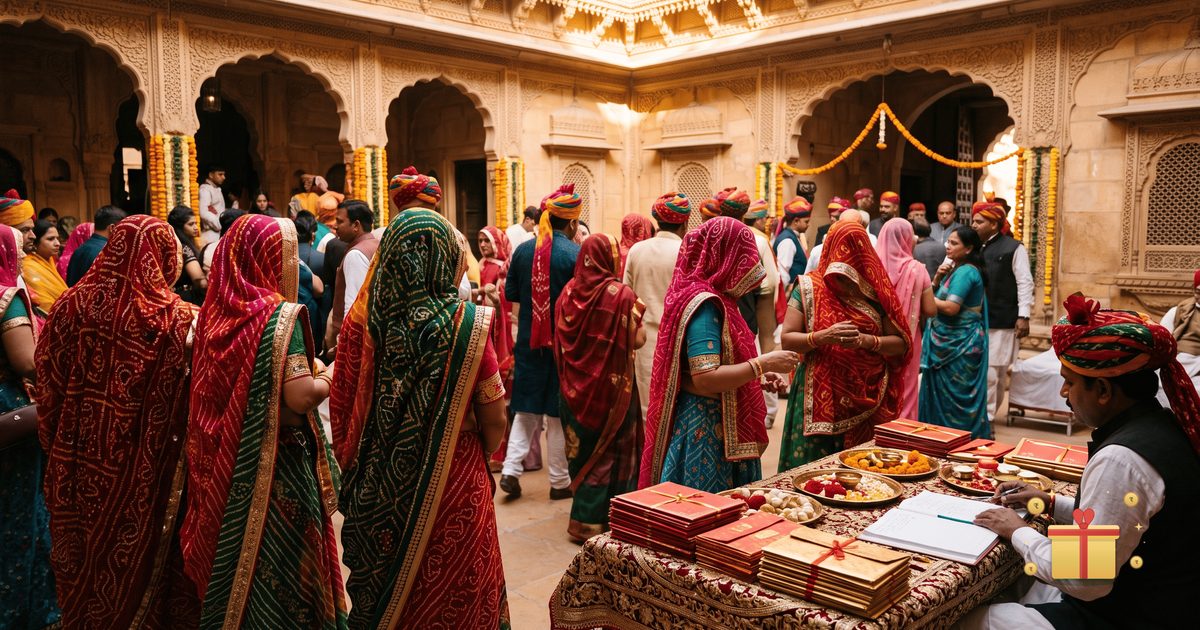
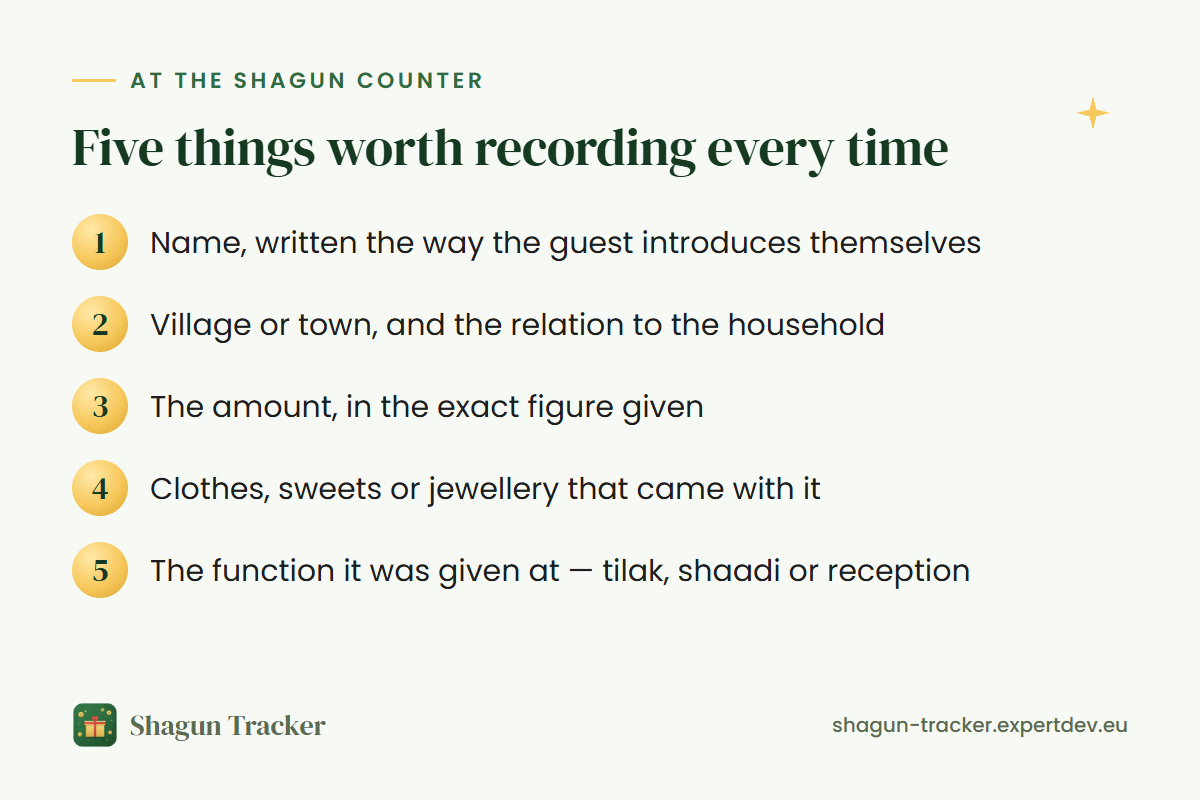
The traditional method is the bahi or register, kept open at the gift table with columns for the name, the village and the amount, filled in as each envelope arrives. In a lot of Bihari families these registers are genuinely treasured objects, pulled out and read before the next wedding. They are also fragile.
What goes wrong
- Envelopes with no name. A handful at every wedding, unidentifiable by the end of the night.
- Two people writing in one register. When the queue builds, entries get repeated or missed.
- Clothes and jewellery left out. They are harder to note in a hurry, so they often go unwritten.
- Gifts handed to relatives, not the table. The envelope given to a chachi during the meal never reaches the book.
- Names without addresses. Half a dozen guests share a surname and there is no way to tell them apart later.
- The register itself. Twenty years on it is faded, water-damaged or lost in a move.
Habits that help
- One person, one list. Decide before the function who records, and send every envelope to them.
- Record at the moment of receiving, not at 2am when the ₹2,100 envelopes have blurred together.
- Always note the relation and the village, not just the name.
- Write down clothes and jewellery too, in plain words: a Bhagalpuri silk saree, a gold ring, a steel dinner set.
- Keep a note of the neg you gave, so the next wedding in the family has something to work from.
- Copy it the same week. Photograph the pages or export a file and send it to two relatives so it survives in more than one place.
Hosts who want a step-by-step plan for the gift table itself should read the shagun counter checklist for hosts before the function, not during it.
Doing it on a phone instead
Many families have simply moved the bahi to a phone. The reasons are practical: the phone is already at the table, it totals the cash as you go, and afterwards a name can be found in seconds instead of by reading page after page.
Shagun Tracker was made for this. You create an event for the function, add each guest with a name, address and relation, and record what they gave — money, clothes, gold or something else — with the totals updating as you go. Afterwards you can search any name in Hindi or English, and export the whole list as a PDF or a spreadsheet to share with the family. It works offline, which matters in a marriage hall with no signal.
Why any of this is worth doing
Writing shagun down is not about treating a wedding as an account. It is the opposite: the register is how a family remembers who stood with them, so that the gesture can be returned properly when the turn comes — a daughter's wedding, a mundan, a new house. The names and the rituals change as you move across the country — tattwa and ashirbad in a Bengali wedding, milni and the lifafa in a Punjabi one — but the thing being recorded is the same everywhere, and it only lasts if somebody wrote it down.