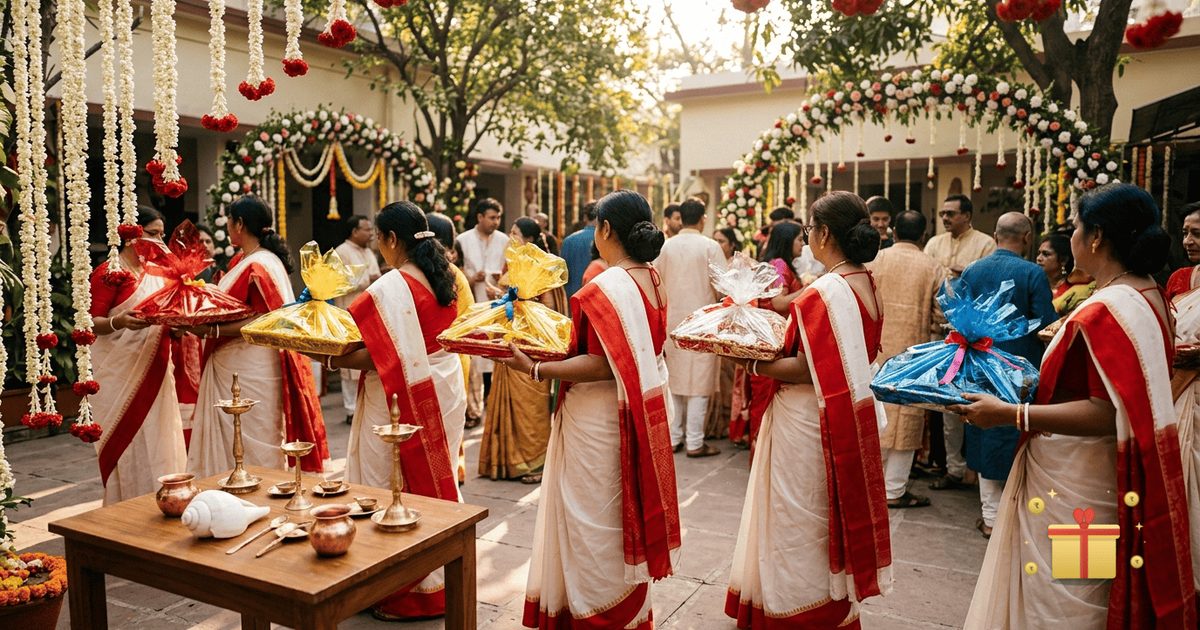
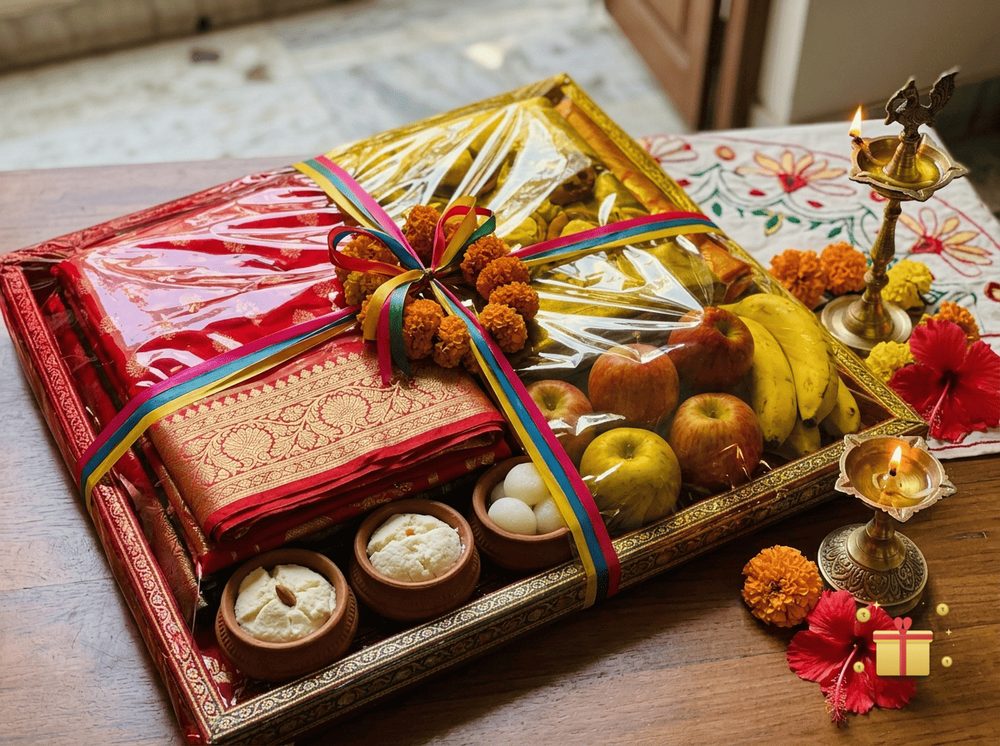
Bengali wedding tattwa is the part of the wedding guests notice first and understand last. Long, decorated trays arrive covered in cellophane and paper flowers, carrying sarees, sweets, fish, fruit, cosmetics, a wristwatch, a set of bangles — and every item on them has been chosen by somebody with a particular relative in mind. It looks like display. It is actually a message from one family to another, sent in objects rather than words.
If you are attending a Bengali wedding, most of what you need to know is small and practical. If you are hosting one, you have the harder job, because gifts come in as objects at least as often as cash, and objects are the first thing a gift register loses. This guide covers both sides.
Gifting in a Bengali wedding: the idea behind it
Bengali wedding gifting is built around two households acknowledging each other rather than two individuals exchanging presents. Tattwa goes both ways: the bride's family sends trays to the groom's, and the groom's family sends trays back. The point is not the value of any one item but the fact that somebody thought about each person on the other side and sent something meant for them specifically.
Cash follows the same convention as the rest of the country. Envelopes carry odd amounts ending in one — ₹101, ₹501, ₹1,100, ₹2,100, ₹5,100, ₹11,000 — so the figure reads as an opening rather than a closed total.
Practice varies enormously. A family from Bardhaman, one from north Kolkata, one with roots in Bangladesh and one from a Bengali community elsewhere in India will each do this differently, and none of them is doing it wrong. Take what follows as the general shape.
Where gifts move: the sequence of functions
Ashirbad
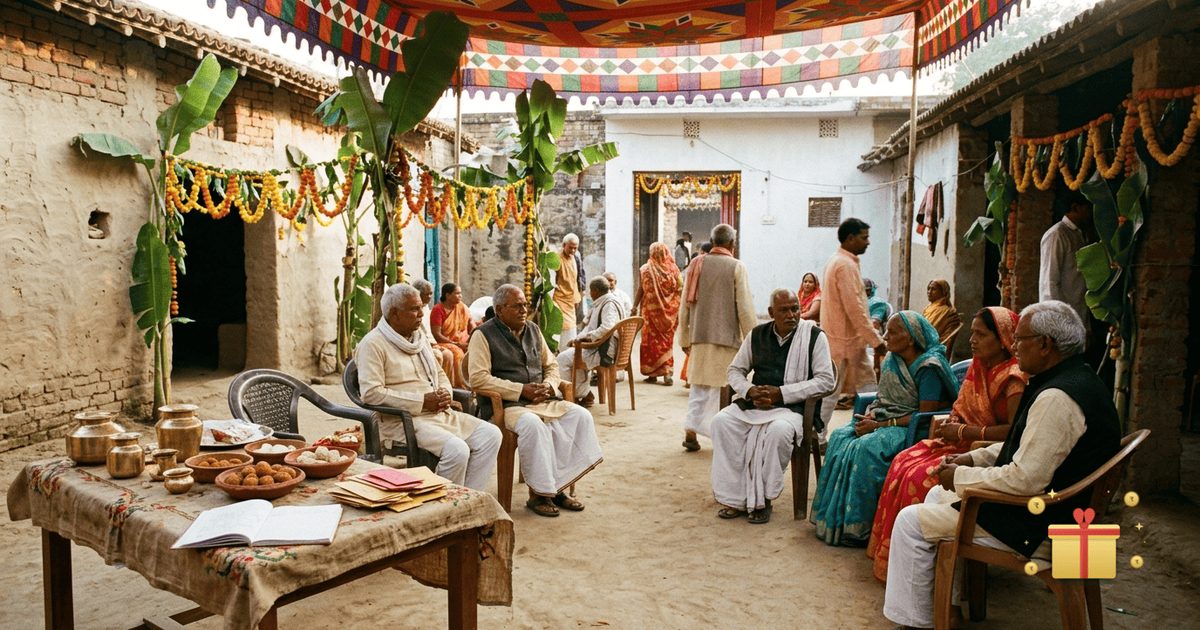
Before the wedding, elders from each family bless the bride and the groom. Husked paddy, dhaan, and durba grass are commonly used, and gifts of clothing or jewellery are usually given at the same time. In many families this is where the alliance is first formally acknowledged in front of a wider circle of relatives, which makes it the first function where anyone genuinely needs to be writing things down.
The tattwa trays
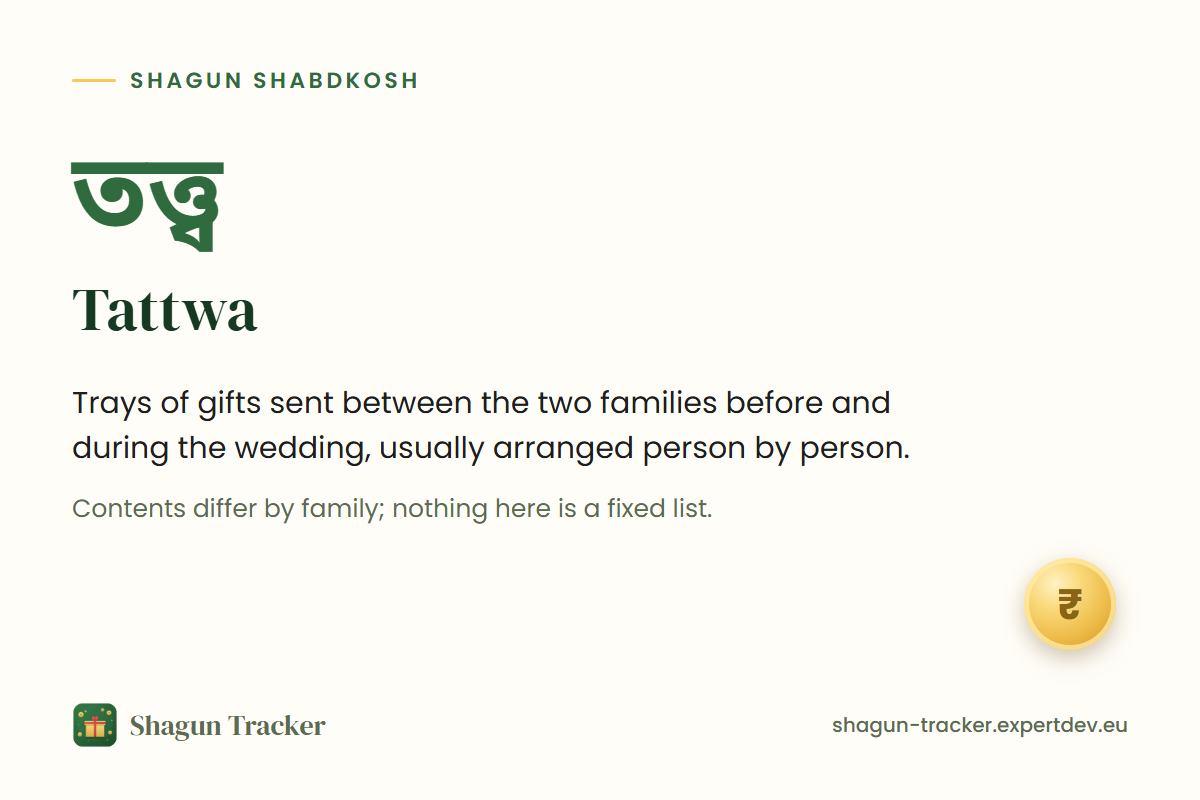
The trays are assembled over days, often by several people working together. What goes on them is a household decision, but the trays are generally organised by person — this one for the groom, this one for his mother, this one for the younger cousins — and are decorated elaborately before being sent across. A fish is traditionally part of the tattwa in many families, and sweets and curd almost always are.
Gaye holud
Turmeric is sent from one house to the other along with more trays, and the paste is applied to the bride and groom at their respective homes. It is a busy, informal, crowded function, and gifts handed over during it are the ones most likely to escape any record.
The wedding day
Relatives on both sides gift openly during the day, and much of it is clothing. The immediate families have usually planned this in advance, person by person, in much the same way the tattwa trays were planned.
Bou bhaat
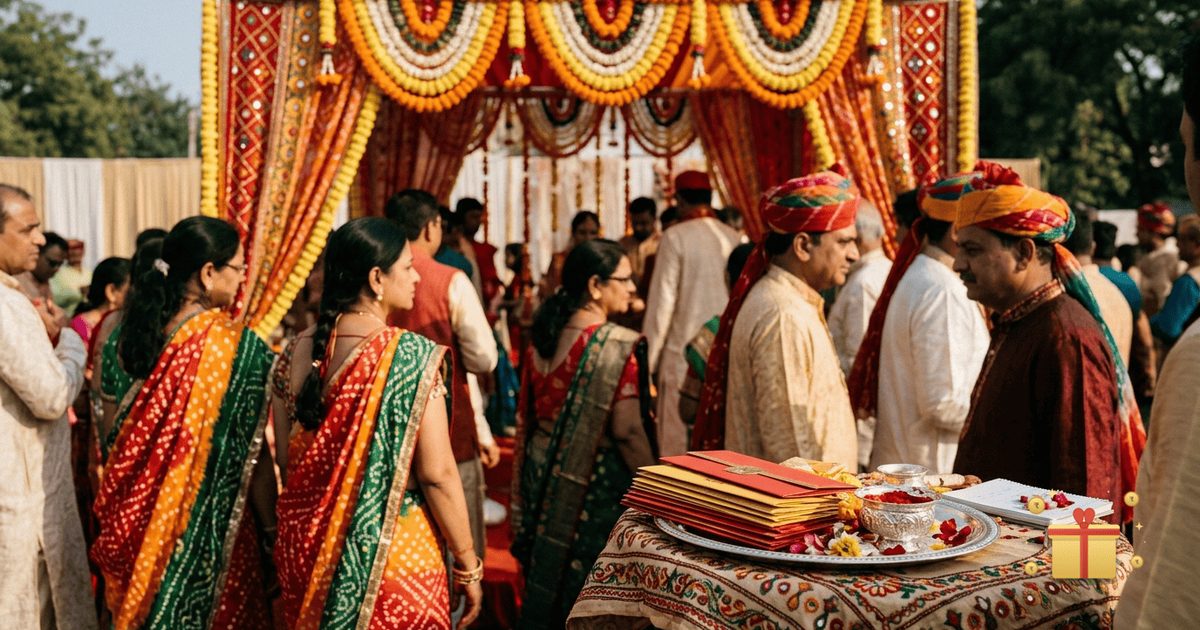
The reception hosted by the groom's family is the volume event, and where most guest gifting happens. Envelopes, household items and clothes arrive together over a couple of hours, and the same guest often gives more than one thing. This is where the record is made or lost.
What guests usually give
| Who | What is commonly given |
|---|---|
| Colleagues and acquaintances | An envelope with a modest odd amount, such as ₹501 or ₹1,100 |
| Friends | An envelope, or a household gift the group buys together |
| Relatives | Clothing or jewellery, usually with an envelope alongside |
| The maternal side | Traditionally generous gifting, and often the most talked about |
| The two families to each other | Tattwa trays planned person by person for the other household |
Two small things matter more than the amount. Put your name on the envelope or the gift tag, because an unnamed gift leaves the family unable to thank you and unable to return the gesture when your own function comes. And keep the figure odd. If you would like the reasoning laid out properly, see how much shagun to give at an Indian wedding.
How families keep the record
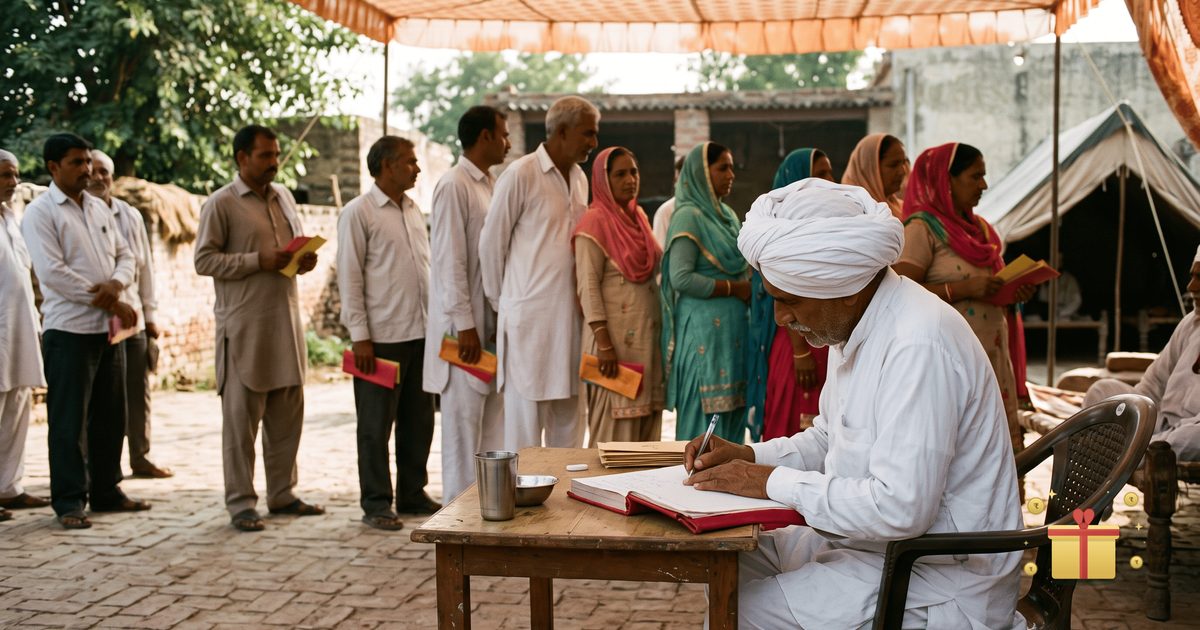
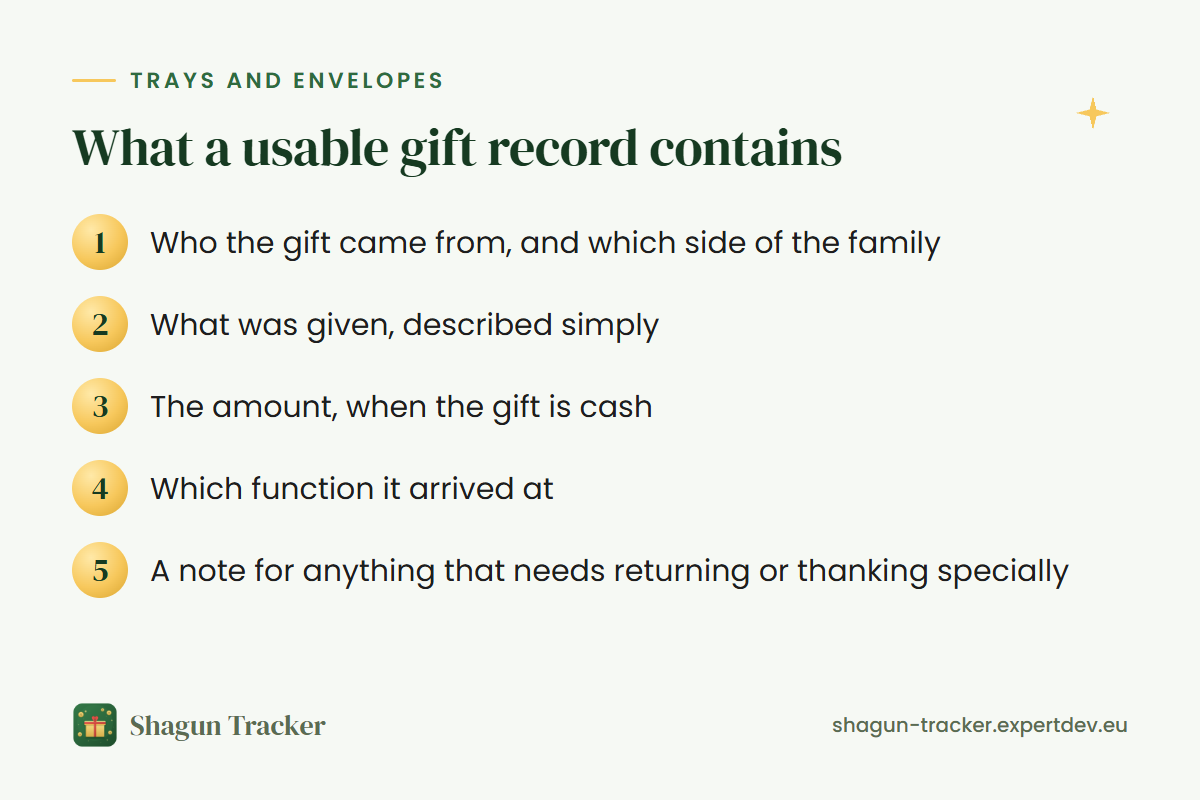
The traditional method is a khata — a notebook kept near the gift table — with the guest's name, their para or locality, and what they gave. It is a good system for cash and a poor one for everything else, which is a problem at a wedding where a great deal of the gifting is not cash at all.
What goes wrong
- Objects written down as "gift". A year later nobody can tell the dinner set from the wall clock, or say who sent which.
- Unnamed envelopes. There are always a few, and by the end of the bou bhaat they are anonymous for good.
- Gifts handed to relatives instead of the table. An envelope passed to a mashi over dinner rarely reaches the khata.
- Tattwa sent, never listed. Families record what arrives and forget to record what they sent, which is half the exchange.
- The notebook itself. Fifteen years on, faded or lost in a move, exactly when the next wedding makes it matter.
Habits that help
- One person, one list. Agree in advance who is recording, and route everything to them.
- Write it as it arrives. Not at midnight, when four ₹2,100 envelopes have merged into one memory.
- Describe objects in plain words. "Bone china dinner set, 24 pieces, from Boro Mama" is a record. "Gift" is not.
- Add the locality and the relation. "Ghosh" is useless in a decade; "Ghosh, Baba's colleague, Behala" is not.
- Keep a list of the tattwa you sent, too. It is the only way to know what the exchange actually looked like.
- Copy it the same week. Photograph the pages or export a file and send it to two relatives.
If you are the person actually running the gift table on the night, read the shagun counter checklist for hosts beforehand — it is the practical version of all of this.
Doing it on a phone instead
The khata has moved to the phone in a lot of families, for unromantic reasons: the phone is already in your hand, it adds the cash up as you go, and afterwards you can find a name in seconds rather than reading eleven pages looking for it.
Shagun Tracker is built around that. You create an event for the function, add each guest with a name, address and relation, and record what they gave — money, clothes, gold or other — so a saree or a dinner set gets written down as itself, with a description, instead of being forced into a rupee column. Totals update live, the list can be searched in Hindi or English, and the whole thing exports as a PDF or spreadsheet for the family. It works offline, which is what you need in a hall with no signal.
Why the record is the point
A tattwa tray is a way of saying we thought about each of you by name. The record is how that survives past the week of the wedding — how, years later, a family knows who stood with them and what to send back when it is their turn. The customs go by other names elsewhere: tilak and shagun in Bihar, milni and the lifafa in Punjab. The obligation to remember is identical.