Marwari shagun customs have a reputation for scale, and the reputation is earned — but scale is not really what makes a Rajasthani wedding distinctive. What makes it distinctive is how many different kinds of giving are running at once. There is shagun between households, recorded by name. There is neg, the small customary token attached to a particular ritual moment. And there is bhaat, the gifting brought by the mother's family, which is a ceremony in its own right. Knowing which is which is most of what a guest or a first-time host needs.
Rajasthan is not one tradition. Marwari, Rajput, Jain, Agarwal, Brahmin and dozens of other communities do these things their own way, and a family in Jodhpur may run a wedding quite differently from one in Shekhawati or Udaipur. What follows is how the customs are generally practised, not a rulebook.
Shagun between households
The core of it is familiar across north India: an auspicious cash gift, given by one household to another, in an amount that ends in one. ₹101 and ₹501 are everyday tokens; ₹1,100, ₹2,100, ₹5,100 and ₹11,000 all turn up in envelopes at a wedding. The extra rupee is the whole point of the figure — it keeps the amount open rather than closed, so the relationship is understood to continue past this function.
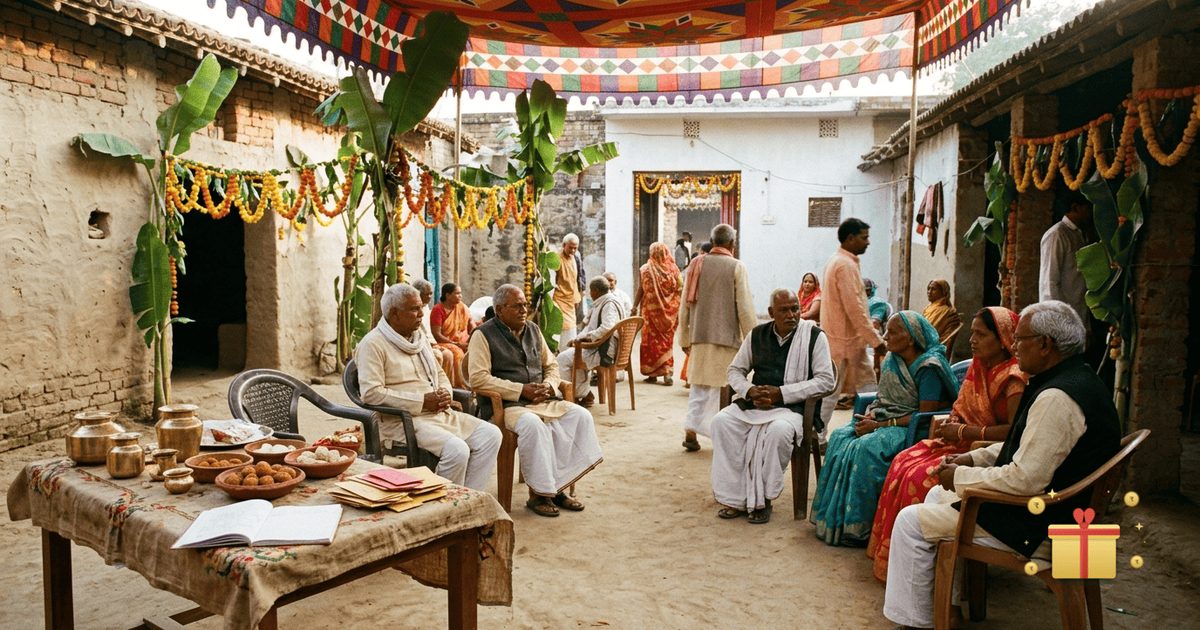
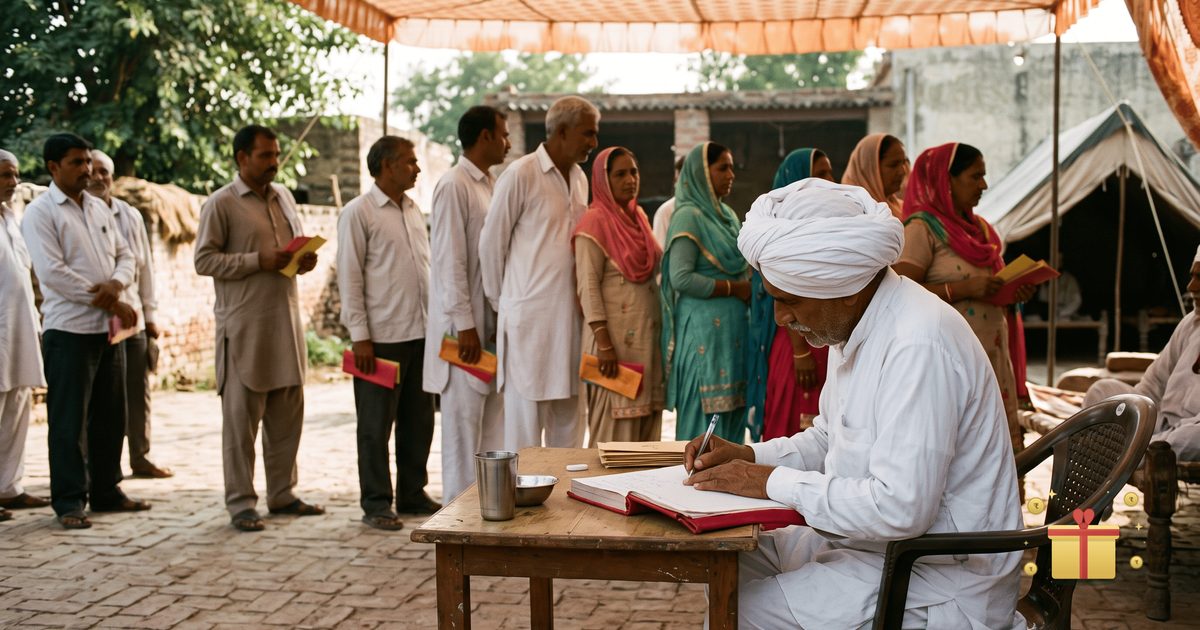
Many Rajasthani families run this as an explicitly recorded exchange, often called neonda or simply vyavhar, in which what each household gives is written in a book and returned when their own function comes. It is a close cousin of the Haryanvi system described in our piece on the neota gift register custom in Haryana, and where it is followed, the register is treated as a family document rather than a convenience.
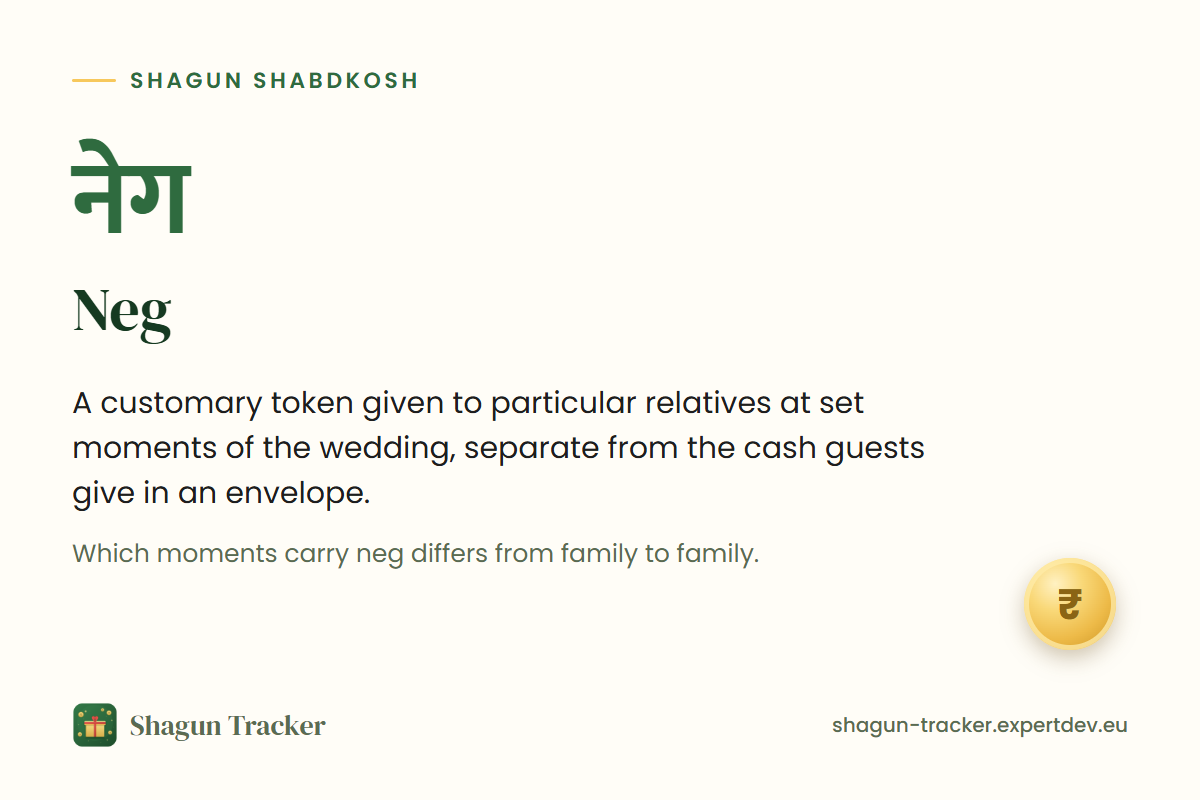
Shagun is what one household gives another. Neg is what a moment in the ceremony is owed. Bhaat is what the mother's family brings. They are three separate things, and confusing them is how guests end up embarrassed.
The moments where gifts change hands
Sagai and tilak
When the match is settled, the two families visit each other with sweets, dry fruit, clothes and shagun. In many Rajasthani and Marwari families, a tilak ceremony at the groom's home is the formal marker, with the bride's father, brothers and close male relatives presenting gifts and applying a tilak. These are household-to-household gifts and are usually the largest recorded entries of the whole wedding.
Bhaat and mayra
Some days before the wedding, the mother's family arrives for bhaat — called mayra in many communities. Her brothers and their families come with clothes, jewellery and cash for their sister and her children, and the party is received at the door with ceremony. In many families the invitation to the maternal side is itself a small formal occasion held earlier, so that everyone knows the date is fixed.
The emotional weight of bhaat is hard to overstate: it is the moment the mother's side stands up publicly for her. What is brought, who brings it and how it is presented differ widely between communities, and anyone attending should simply follow the host family's lead rather than assume a standard script.
Neg at the small moments
Neg is the lighter layer, and Rajasthani weddings are full of it. The bride's sisters and cousins hiding the groom's shoes and negotiating their return is the best known, but there are others: the women who stop the baraat at the door, the bhabhi who performs a particular ritual, the relatives who guide the couple through a step. Amounts are usually modest — ₹101, ₹501, sometimes ₹1,100 — and the exchange is a performance as much as a payment.
Neg is generally not entered in the register, because it belongs to the moment rather than to the household account. It is worth carrying small odd amounts in an inner pocket if you are in the groom's party, because neg tends to arrive without warning.
The wedding days and after
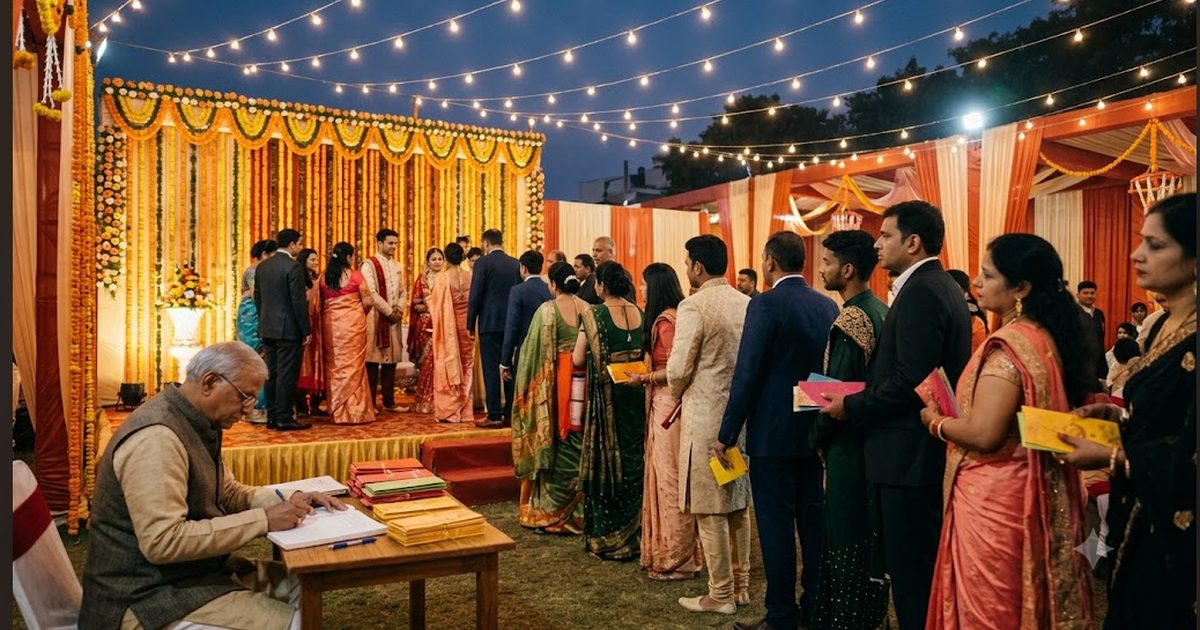
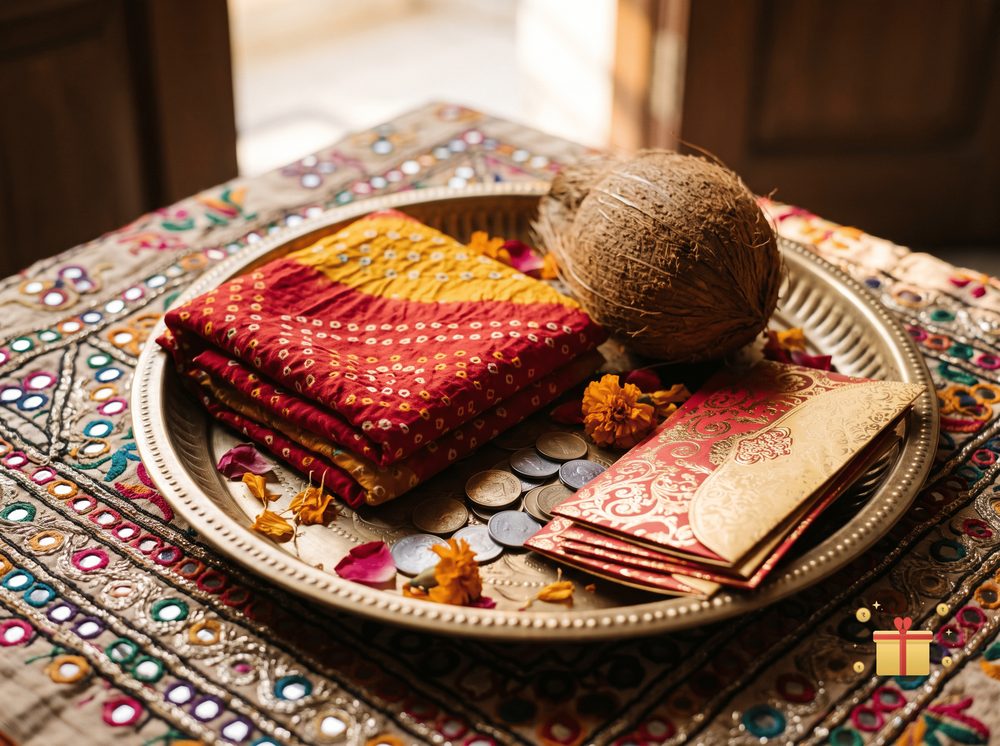
At the wedding and the reception, envelopes arrive continuously — handed to someone at the gift table, to a family member on the way in, or to the couple on stage. Clothes and jewellery arrive alongside cash, and one guest often gives more than one kind of gift. Gifting continues afterwards through the visits between the two families, which is where several of the year's most significant gifts are exchanged.
What guests usually give
- Colleagues and acquaintances give a modest odd amount that acknowledges the invitation.
- Friends usually give more, often settling on a common figure among themselves.
- Relatives give according to closeness, and frequently in line with what that family gave them earlier.
- The maternal side gives generously by long tradition, and in many families this is a matter of pride rather than obligation.
Two practical things matter more than the figure. Write your name on the envelope — an unnamed envelope means the family cannot thank you properly or return the gesture later. And keep the amount odd. If you want a fuller walk-through, see how much shagun to give at an Indian wedding.
How families keep the record
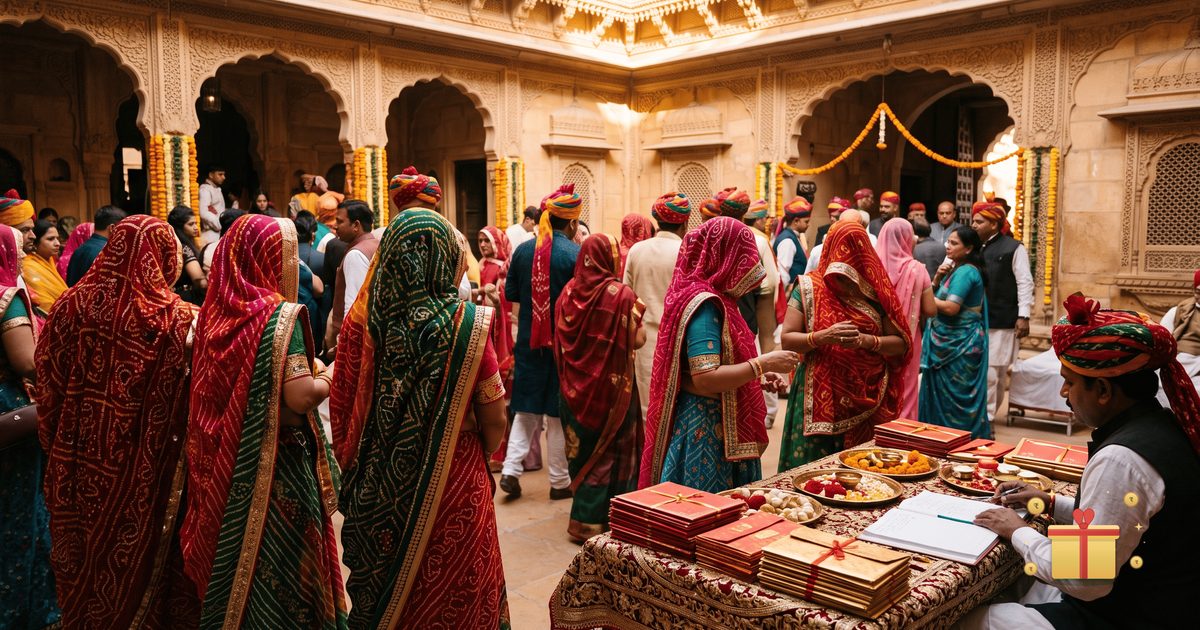
A Rajasthani wedding can bring several hundred households through the door in a single evening, each with an envelope, and the record has to survive both the crowd and the next twenty years. The traditional method is a register at the gift table with columns for name, place and amount. It works well until the queue builds up.
Where records break
- Envelopes with no name, which are unidentifiable by the end of the night.
- Two people writing in one register, producing duplicates and gaps at the same time.
- Gifts in kind left unrecorded because a saree or a set of bangles is slower to write than a number.
- Common surnames with no address — three Agarwal families in one book and nothing to tell them apart.
- The book itself, faded or lost in a house move, missing exactly when the next function needs it.
Habits that hold up
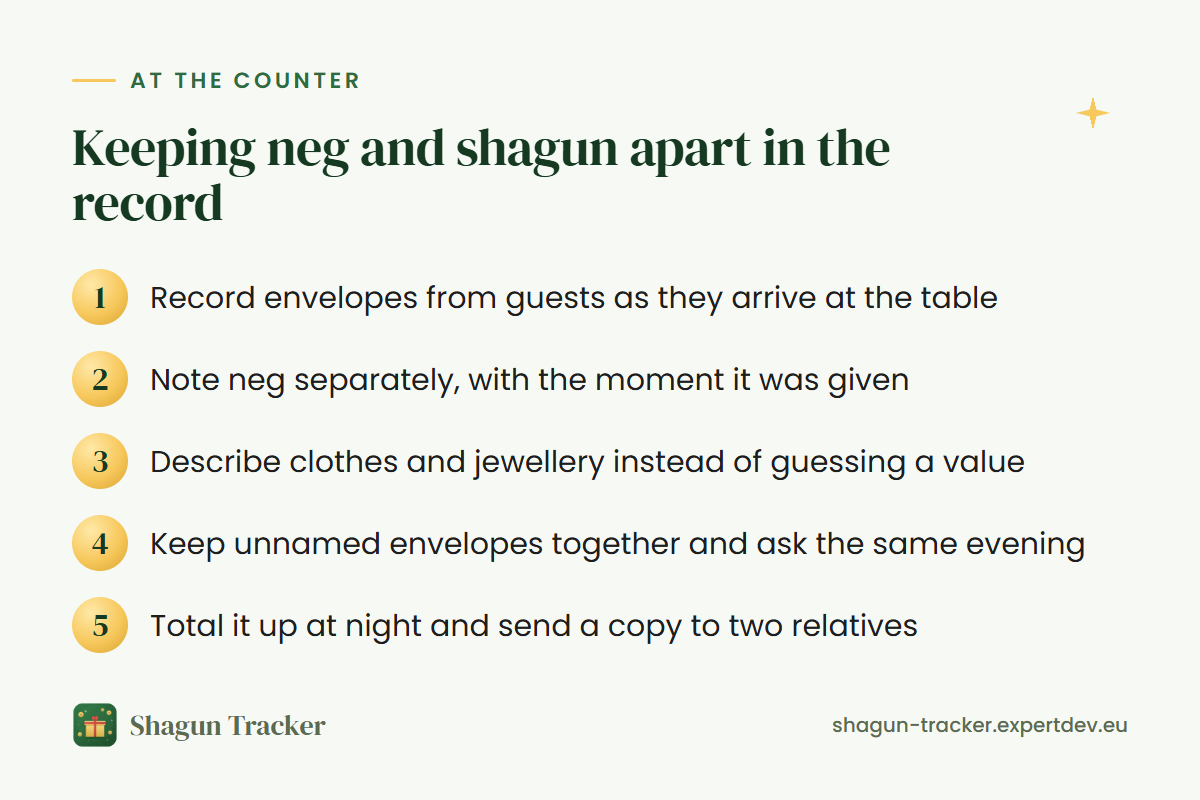
- Appoint one recorder and one list before the function starts, and route everything through them.
- Record as the envelope is handed over, not later from memory.
- Always write the town, village or mohalla next to the name.
- Note the relation — maternal side, paternal side, friend, neighbour, colleague.
- Write gifts in kind in plain words: a Bandhani saree, a gold chain, a silver tray.
- Make a copy the same week and give it to two other people in the family.
Doing it on a phone
A lot of families have moved the register to a phone for unglamorous reasons: the phone is already in hand at the table, it totals as you go, and a name can be found instantly afterwards instead of by turning pages.
Shagun Tracker is built for exactly this job. Create an event for each function — sagai, the wedding, the reception — add each guest with name, address and relation, and record what they gave, whether that is cash, clothes, gold or something else, with a notes line for anything you will want to remember later. Totals update as you enter, names can be searched in Hindi or English, and the whole list exports as a PDF, CSV or backup file to send to the family. It works offline, which matters in a hotel banquet hall or a haveli courtyard with no signal.
Families who already keep an Excel sheet from a previous function can import it as a CSV into an event, so the old list and the new one live together. Hosts setting up the table itself will find the shagun counter checklist for hosts useful on the day.
The reason any of this is written down
Rajasthani gifting looks elaborate from outside, and it is, but the logic underneath is simple and shared across the north — the same logic you will find in Punjabi shagun and milni customs or in the tilak and shagun traditions of Uttar Pradesh. A wedding of this size was never something one household could carry alone. The register is how a family remembers who helped carry it, so that when that household's turn comes, nobody has to rely on memory.