South Indian wedding gift customs look very alike from across the hall. A guest arrives, hands over an envelope, gets a bag of betel leaves and fruit on the way out, eats on a banana leaf and leaves. Underneath that, Tamil, Telugu, Kannada and Malayali families do this quite differently, and even within one language there is real variation between communities, districts and families.
This guide walks through what guests usually give, what hosts give back, and how the record is kept, without pretending that any one version is the South Indian way. If you are attending a wedding and want a single reliable rule, here it is: ask someone close to the family. Everything below is context for that conversation.
The ideas that hold across the South
- The gift goes to the family, not the couple. At most South Indian weddings you hand your envelope at a table or to a relative, not to the bride and groom on stage.
- It is recorded. In many families the name and amount are written down as they arrive, so the gesture can be thanked and returned later.
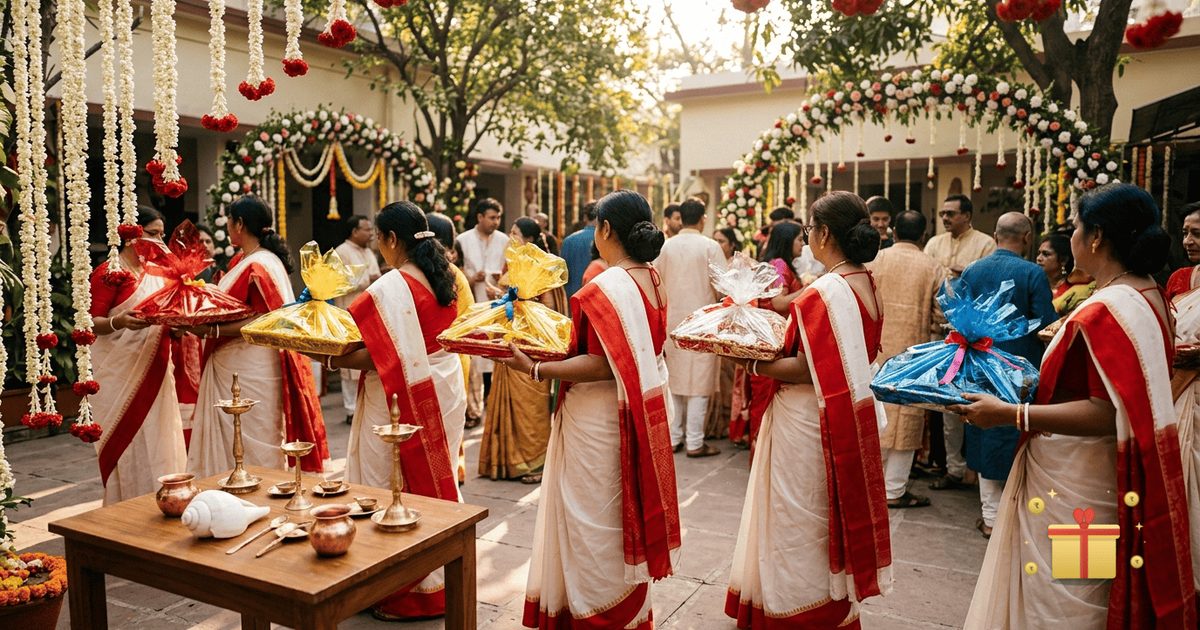
- The host gives back. Guests are sent home with something, most commonly a tamboolam bag.
- Reciprocity is long-term. What a family gives you at your function shapes what you give at theirs, sometimes decades later.
- Odd amounts. Figures ending in one, like ₹101, ₹501, ₹1,100 or ₹5,100, are common across communities.
Across the South, the envelope is the smaller half of the custom. The larger half is that somebody wrote your name next to it, and the family will remember.
Tamil weddings
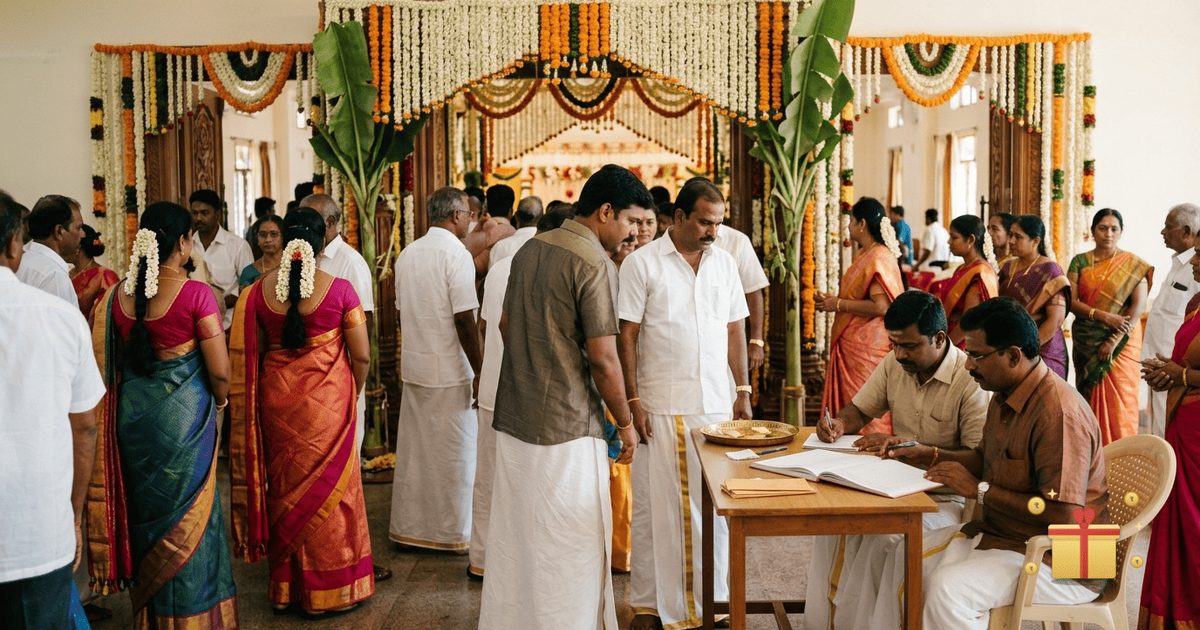
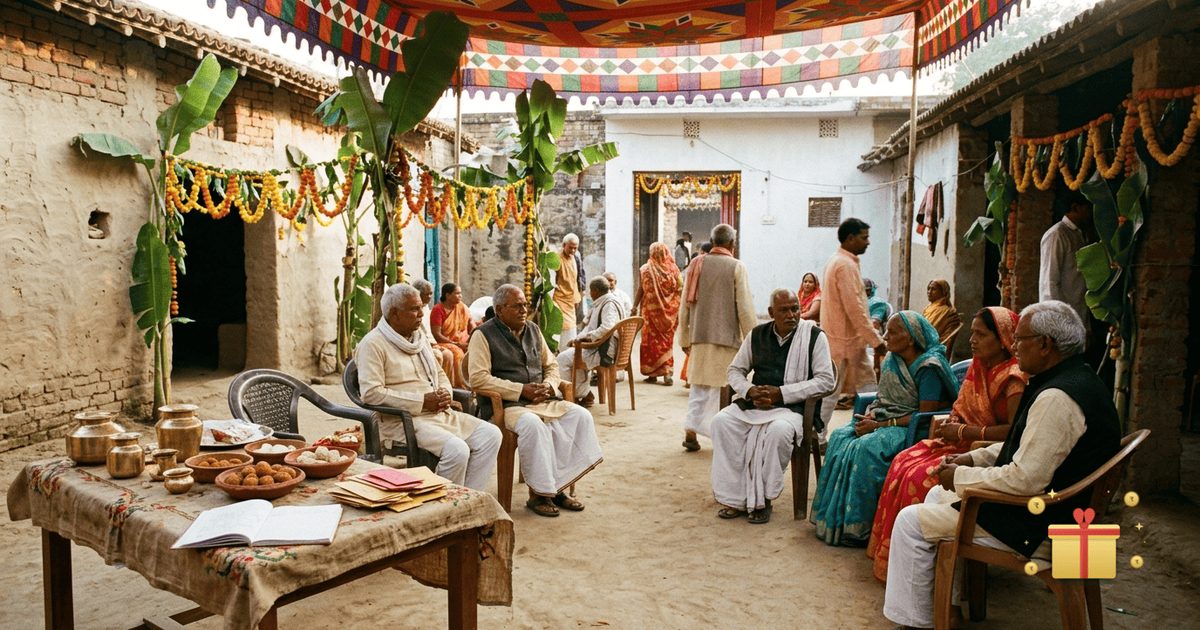
Tamil families have the most formalised version of this, and it has a name: moi. The gift is handed at a table, written into a long notebook with the guest's name, village or area and amount, and at many village functions announced over a microphone as it is received. The same notebook is consulted years later before the family gives at someone else's wedding.
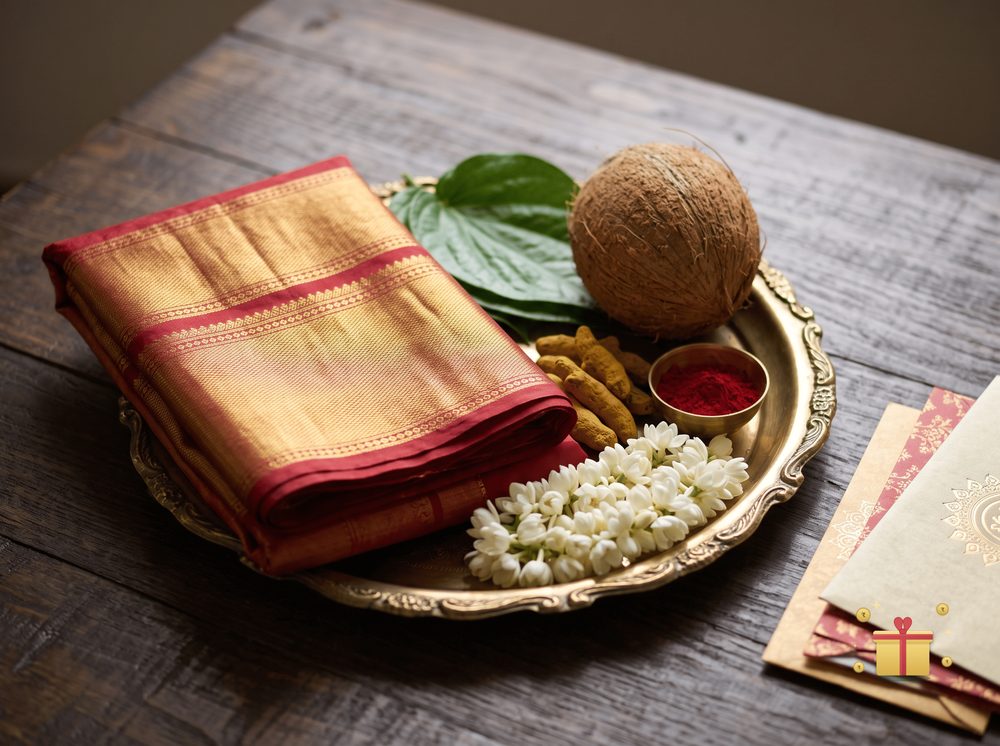
Gifts in kind are common alongside cash, especially from close relatives: silk sarees, silver items, gold for the bride from her own family and relatives. Guests typically leave with a tamboolam. Because the moi custom is the closest Indian parallel to a formal gift register, we have covered it separately in moi in Tamil weddings and how the register works, including moi ezhuthu and moi virundhu.
Telugu weddings
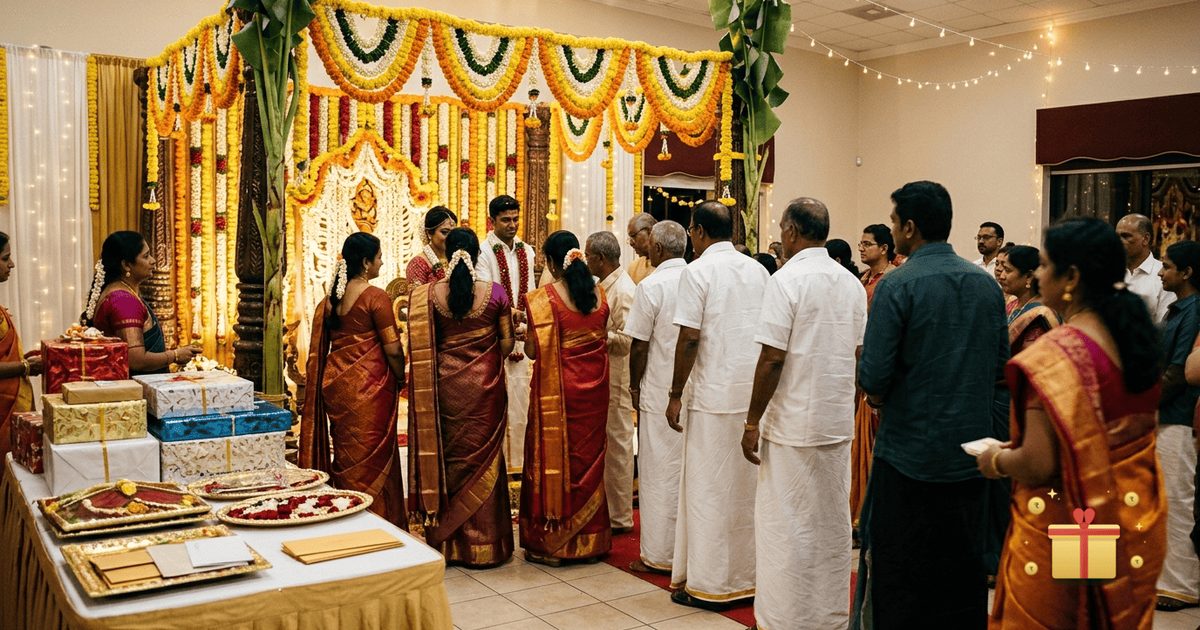
Telugu weddings across Andhra Pradesh and Telangana are usually long, well attended and generous with return gifts. Cash in an envelope is standard from guests, handed to a family member or left at a designated counter. In many families someone keeps a list as envelopes come in, though it is less formalised than the Tamil moi table and more likely to be a household habit than a public ritual.
Two things stand out for a guest:
- Return gifts are taken seriously. A tamboolam is given to guests, and married women are often given turmeric, kumkum and a blouse piece as a mark of respect. Larger functions may add sweets or a souvenir.
- The engagement matters. The formal engagement function draws close relatives and its own round of gifting, so a family may end up with two or three separate guest lists for one wedding.
Community makes a real difference here. Practice in a coastal Andhra family, a Telangana family and a family settled in Hyderabad for three generations will not be identical, and none of them is doing it wrong.
Kannada weddings
In Karnataka the pattern is broadly similar: an envelope handed to the family, a tamboolam or return gift on the way out, and turmeric and kumkum offered to women guests. The Kannada word muyyi carries the idea of a gift given in return for one received, which is the same reciprocal thread that runs through moi and through North Indian shagun.
Weddings here range widely, from short temple ceremonies with a small gathering to large hall functions with a reception the previous evening. That range affects gifting more than anything else: at a small ceremony a gift in kind or a modest envelope is entirely appropriate, while a big reception tends to follow the familiar envelope-and-counter routine.
Malayali weddings
Kerala weddings are often noticeably shorter than their neighbours', and the gifting culture tends to be more understated. At Hindu ceremonies the ritual itself can be over in minutes, followed by the sadya served on a banana leaf. Many guests give an envelope, often at the reception rather than the ceremony, and quite a few close relatives give gifts in kind or gold to the bride as a blessing from her own family and relations.
Kerala also has a particularly mixed wedding landscape. Christian and Muslim families have their own well-established patterns, with the reception usually the main gifting occasion, and what is normal in Thrissur may not match what is normal in Malappuram or Kottayam. Ask before assuming, especially about whether cash is expected at all.
What guests usually give
There is no scale to follow, but the shape of it is consistent: acquaintances and colleagues give a token that acknowledges the invitation, friends give more and often agree an amount between themselves, close relatives give considerably more, and the bride's and groom's maternal families are frequently the most generous of all. Where you live matters too, since a metro wedding and a small-town wedding sit at different levels for everything.
If you want to think it through properly for your own situation, our guide on how much shagun to give at an Indian wedding works through relationship, city and reciprocity in detail.
How families keep the record
Whatever the community, the family ends up with the same job on the day: several hundred people arriving over a few hours, each leaving something behind, and one person responsible for making sure none of it goes unrecorded.
The failures are identical everywhere:
- Envelopes with no name. They arrive at every function, and no amount of guessing recovers them afterwards.
- Several people collecting. An uncle at the door, a cousin near the stage and a friend by the dining hall each end up with a pile and no shared list.
- Names with no context. Three guests called Ramesh and nothing to tell them apart in five years' time.
- Gifts in kind left out. A saree, a silver lamp or a vessel set is harder to write than a number, so it gets skipped.
- UPI transfers. Money that arrives on a phone while the register sits on a table is the newest way for a gift to vanish from the record.
What works
- Name one recorder before the function and send every gift through them.
- Write the entry as it is received, with name, place and relation.
- Record gifts in kind in plain words: "silk saree", "silver lamp", "gold chain".
- Check the UPI history against the list at the end of each day.
- Make a second copy the same week and give it to another family member.
Keeping the list on a phone
Many families have moved this to a phone, not because the notebook failed but because the phone is already in hand at the counter. Shagun Tracker is made for it: create an event for each function, add every guest with name, address and relation, and record what they gave, cash or clothes or gold or anything else. Totals update as you go, search works across Hindi and English, and the list exports as a PDF or spreadsheet to share with the family. It works offline, which matters in a hall with poor signal.
One last thing for guests
Write your name on the envelope. It sounds trivial and it is the single most useful thing a guest can do. A family that cannot identify your envelope cannot thank you for it, and cannot return the gesture when your own function comes around, which is the entire point of the custom in every one of these communities. The same holds far beyond the South, as anyone who has run a gift table at a Punjabi wedding will tell you.